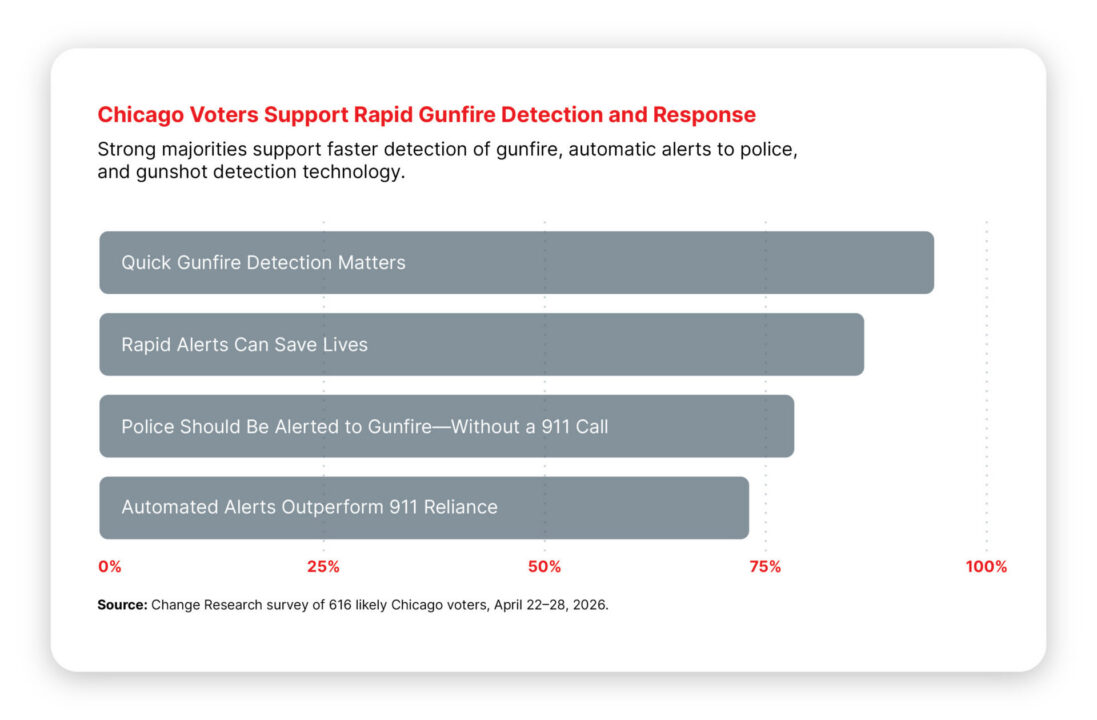
94% said it is important that the City has the ability to quickly detect and respond to gunfire incidents.
What Chicago Voters Think About Gunshot Detection, and Why We Asked


Investors and analysts ask us a version of the same question all the time. When a city turns into a battleground over gunshot detection, does that fight actually reflect what the people who live there want? We didn’t want to guess, so we asked the citizens of Chicago.
We picked Chicago on purpose. It’s about the most politically contested market there is for this technology, which makes it the right place to test the question. If support holds up where the politics are loudest, that tells you something real about demand everywhere else.
So we commissioned Change Research to run an independent survey of how Chicago voters see gun violence, police response, and gunshot detection. We’re publishing all of it, toplines and crosstabs and methodology, so you don’t have to take our word for any of it. These are all available for download at the end of this article.
Change Research surveyed 616 likely Chicago voters from April 22 to 28, 2026. The modeled margin of error is ±4.4%.
What We Found
Crime and public safety still sit near the top of what worries Chicago residents.
And there’s broad, deep support for letting police detect gunfire and respond to it fast.
Among the findings:
86% said it is important that police are automatically alerted to gunfire so they can respond quickly and potentially locate victims who may be unable to call for help.
78% said police should be automatically alerted when gunfire occurs, even if nobody calls 911.
60% said automatically alerting police through technology is more effective than relying primarily on 911 calls and other methods.
After hearing arguments from both supporters and opponents, 69% supported the use of gunshot detection technology in Chicago.
Support Across Affected Communities
People often ask whether the support is broad or whether it comes from neighborhoods that don’t feel the violence day to day. The data answers that directly.
It ran highest on the Southeast Side, where 88% backed the technology after hearing the case from both sides.
It ran strong in other communities hit hardest by gun violence too: Black voters at 80%, the Southwest Side at 79%, Latino voters at 78%.
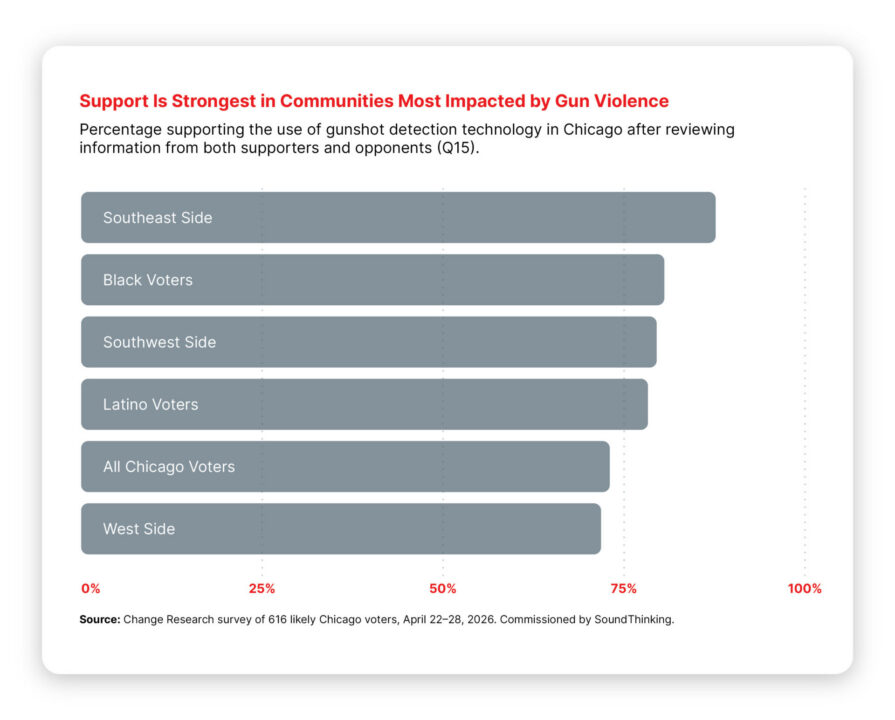
This isn’t support from the sidelines. The people living closest to the problem are the ones backing the technology most.
The Demand Hasn’t Gone Away
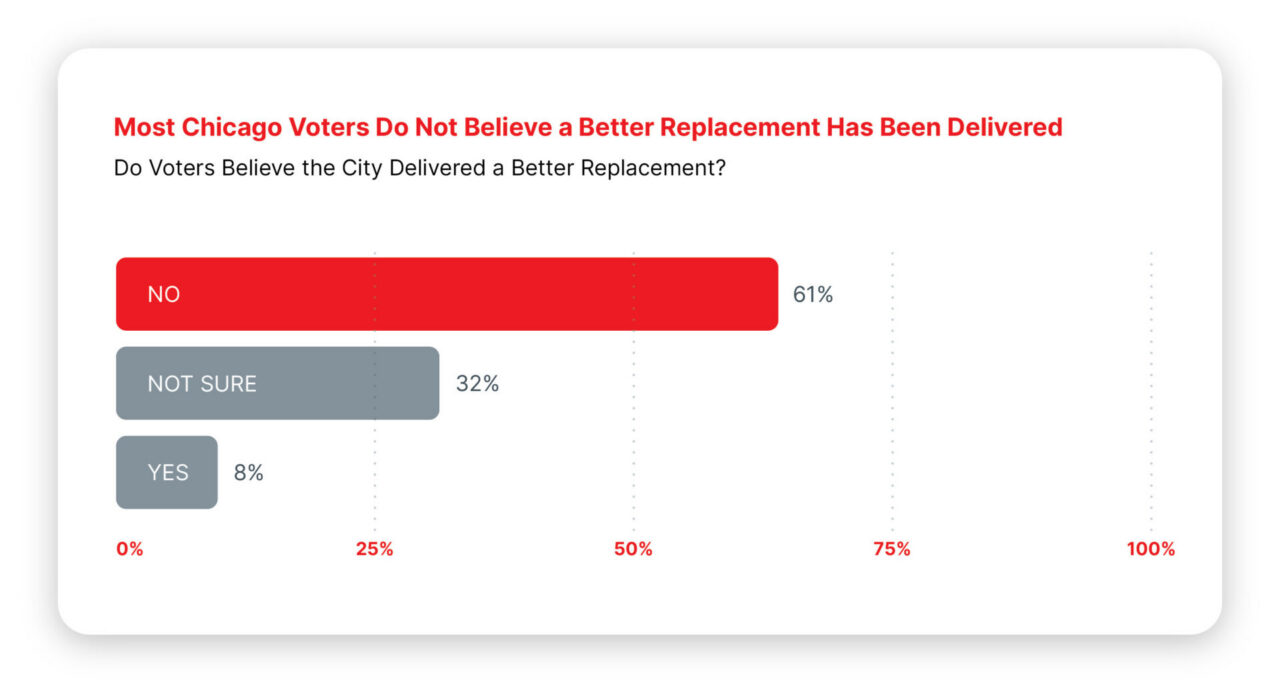
We asked whether a clearly better alternative had been put in place. 8% said yes. 61% said no.
For an investor, that’s the point. Demand for fast, reliable gunfire detection didn’t disappear when the politics got complicated, and voters don’t believe anything better has shown up to replace it.
Whether voters think a better alternative is in place.
The Bottom Line
You can argue about budgets, priorities, and how much technology belongs in public safety. Those are real debates.
Underneath them, though, the survey shows a lot of agreement:
Gun violence remains a serious concern.
Residents want gunfire detected and reported quickly.
Residents believe emergency responders should be alerted even when no 911 call is made.
Nearly half of respondents (48%) said elected officials should pursue a balanced approach that combines technology with other public safety strategies.
But the data are clear that voters want gunshot detection to stay part of the mix.
See It Yourself
We’re putting all of it out in the open: toplines, methodology, crosstabs.
Download the complete survey package:
Investors, analysts, reporters, researchers: go through the data and draw your own conclusions.
We’d rather these arguments get settled with data than with noise. That’s why we ran the survey, and why we’re sharing everything behind it.
People will keep debating the policy, and that’s fine. But the question that sent us into the field, whether demand for fast, reliable gunfire detection is real and durable, now has an answer. It is, and it does.
Was this article helpful?


Search for More Insights
Here are some other topics you might be interested in: