











Public trust in law enforcement technology does not come automatically. It is built through transparency and maintained through accountability. Across the country, law enforcement agencies are grappling with how to adopt tools that help keep communities safe while making sure those tools do not overstep privacy boundaries their communities expect. The City of San Francisco has been doing this work deliberately, and its approach to evaluating gunshot detection technology offers a model worth examining.
San Francisco’s ordinance goes beyond evaluating whether a public safety tool is operationally effective. It also requires agencies to address questions, including what the technology does, what data it collects, who can access that data, and how the technology is governed and audited. Those policies, procedures, and disclosures are documented publicly and subject to ongoing review through the City’s surveillance oversight process.
San Francisco Requires Every Surveillance Tool to Pass a Recurring Test
Under San Francisco Administrative Code Section 19B, the city does not simply approve surveillance technology and move on. Covered surveillance technologies must go through a formal review process before it can be used. For a tool to be approved under Section 19B, the Board of Supervisors must affirmatively find three things: that the benefits of the technology outweigh its costs and risks, that the policy governing its use will safeguard civil liberties and civil rights, and that deployment will not be based on discriminatory factors or produce a disparate impact on any protected community. These are rigorous requirements. They demand evidence, public hearings, and documented findings.
At the September 2024 Rules Committee hearing, the Department of Emergency Management presented an updated ShotSpotter surveillance technology policy and walked through the system’s deployment and data handling practices in detail. From there, the Government Audit and Oversight Committee also reviewed these findings in their March 2026 meeting, recommending to send the report and recommendations on to the full Board of Supervisors, who voted to adopt the findings of the surveillance report during their meeting on March 17, 2026.
ShotSpotter Is Engineered to Detect Gunshots, Not Monitor Conversations
One question often raised about acoustic detection technology is how the system distinguishes gunfire from ambient sounds. The technical design of ShotSpotter® is intended to address that question. The sensors are mounted high above street level, typically on rooftops, and are calibrated to recognize loud, impulsive sounds consistent with gunshots. For an alert to be generated, at least three sensors must detect the same acoustic event and triangulate its location. Ambient sounds such as human voices, traffic, music, and other street noise do not meet the system’s detection criteria for generating a ShotSpotter alert.
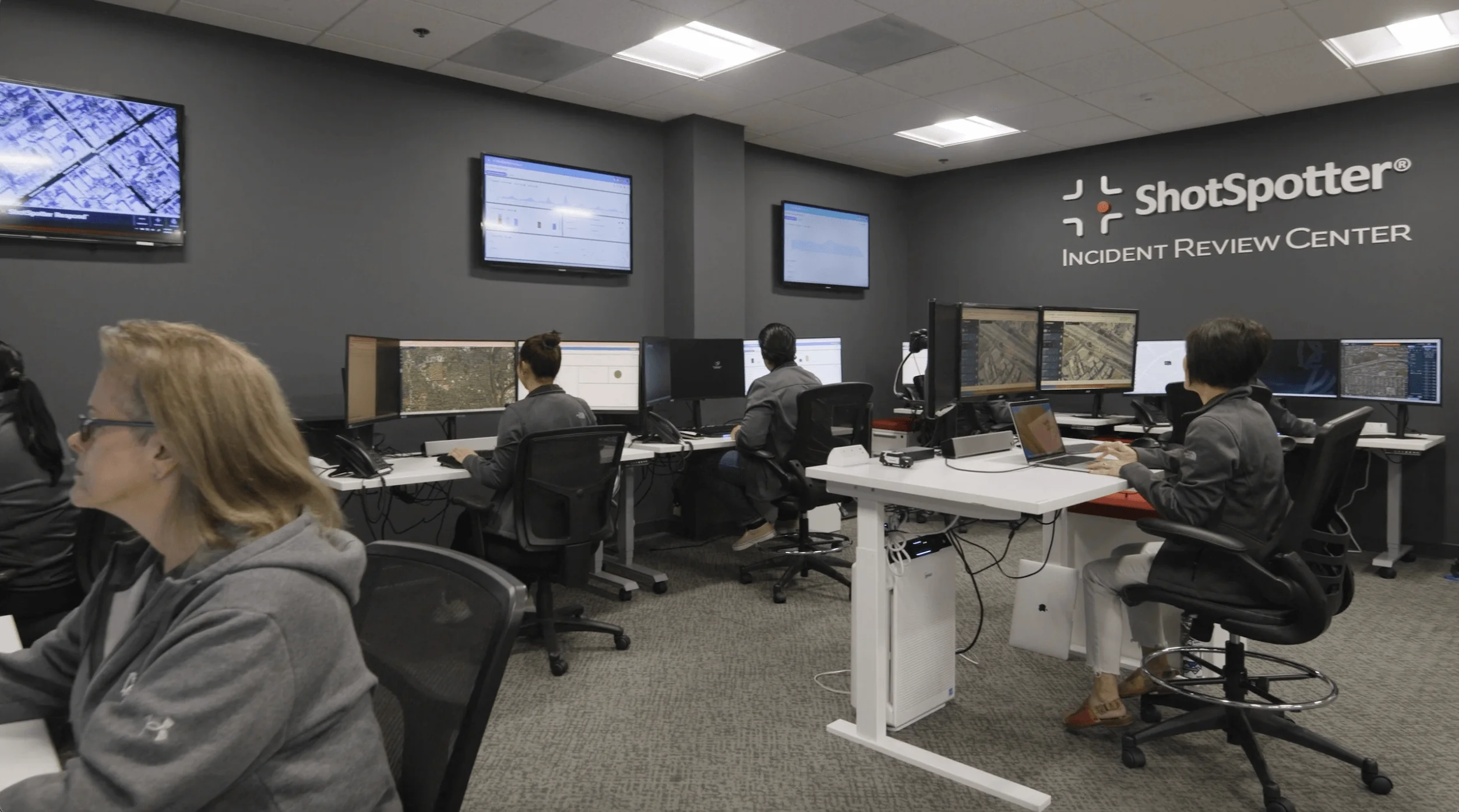
When sensors do detect a potential gunshot, they capture a short snippet: one second of audio before the detected sound and one second after. That snippet goes to ShotSpotter’s Incident Review Center, where trained acoustic analysts confirm whether it is actually gunfire, typically within 60 seconds. The process from trigger pull to published alert averages around 34 seconds. Live audio streaming is not possible. Agencies with ShotSpotter have access to the snippet of gunfire with the alert, but cannot access the sensors remotely or in real time.
What Happens to ShotSpotter Audio Data?
ShotSpotter is built around a simple principle: the system collects only what it needs to detect gunfire. Audio that does not result in a confirmed gunshot is automatically deleted from sensors every 30 hours. When a confirmed gunshot is detected, the only audio shared with the agency is a snippet of a few seconds, just enough to confirm the incident. No personally identifiable information is attached to any alert, and the system has no ability to identify an individual from what it captures.
In 2019, the Policing Project at NYU Law School conducted a full independent privacy audit of ShotSpotter, with complete access to its systems and total editorial control over their findings. Their conclusion was that the risk of voice surveillance is extremely low. Additionally, ShotSpotter adopted all 11 of the auditors’ recommendations, tightening data retention windows, restricting internal access, and formalizing a policy of fighting legal subpoenas for extended audio.
When Seconds Matter, ShotSpotter Answers
In San Francisco, only 15 percent of gunfire incidents in 2019 resulted in a 911 call. That means without ShotSpotter, officers would have had no notification about 85 percent of gunfire events. More than 850 incidents per year were happening in silence. ShotSpotter changed that equation entirely. When a shot is fired, officers receive a verified alert with a precise location within about 60 seconds. That speed matters for victim survival, for securing a crime scene before it degrades, and for officer safety, since arriving with awareness of the location and number of shots, changing the tactical picture entirely.
For a city that continues to find ShotSpotter’s benefits do not compromise community privacy, this year’s findings are not the end of the conversation. That transparency and accountability continue in San Francisco, as they continually review technologies with the same expectation of transparency and public accountability. As a public safety technology product, ShotSpotter is pleased and honored to continue working with a community that is serious about both public safety and individual privacy.