Detailed Forensic Report (DFR) — an expert-prepared, courtroom-ready analysis that determines the timing, cadence, and location of shots and helps assess whether accounts align with the acoustic record. Routine DFRs are completed in two to three weeks, but OIS-related reports are expedited to 24–48 hours.
Using ShotSpotter for Officer-Involved Shooting Cases

Officer-involved shootings are high-stakes events for agencies, prosecutors, and communities. In the first hours, your goals are consistent: stabilize the scene, preserve evidence, and establish an objective timeline. ShotSpotter® Forensic Services can help you do that work quickly and credibly by pairing sensor-derived facts with expert analysis.
How ShotSpotter Forensic Services Supports Your Agency After an OIS
As soon as possible, given the circumstances, contact SoundThinking, either through Customer Support on the app, by phone, by email, or by using the Investigative Services form. Our two forensic reports can be of critical assistance for all shooting investigations, but especially officer-involved shootings (OIS). Given the specific demands of investigators in OIS incidents, agencies should consider requesting Detailed Forensic Reports.
If the investigating agency only seeks to provide initial discovery or documentary proof that there was a ShotSpotter alert for a particular OIS, the Investigative Lead Summary (ILS) provides the basic information.
- Investigative Lead Summary (ILS) — an automated summary with date, time, and approximate location and links to incident audio, available immediately in the ShotSpotter app and indefinitely in the ShotSpotter historical database, InSight.
ShotSpotter forensic experts have testified in courts across 25 states in 400+ cases, serving as qualified expert witnesses rather than mere custodians of records. That credibility matters when you need to explain methods and results to the investigatory and prosecuting agencies, a judge, or a jury.
What the Acoustic Gunshot Detection Data Can Provide in an OIS
ShotSpotter uses acoustic sensors to detect and record audio, and a proven mathematical method to determine the location of shots fired. Each outdoor gunfire alert is based on three or more sensors detecting the same impulsive sounds. Using the identical technique as is used to determine earthquake epicenters—multilateration—ShotSpotter technology calculates shot location based on time-of-arrival data at each of the sensors. The results are provided to customers as both a point location (latitude/longitude) of the gunfire itself and as an associated address, not just a general area.
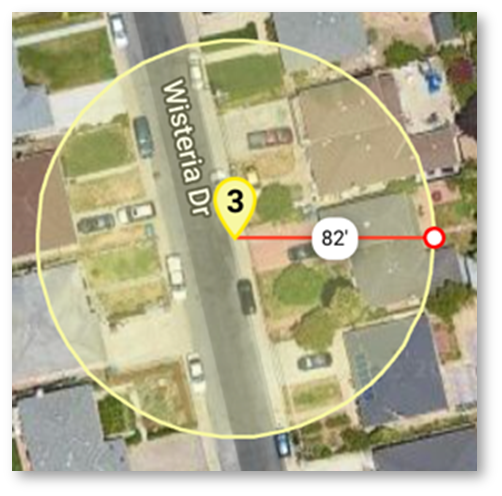
ShotSpotter map showing number of rounds fired, location within a 25-meter radius.
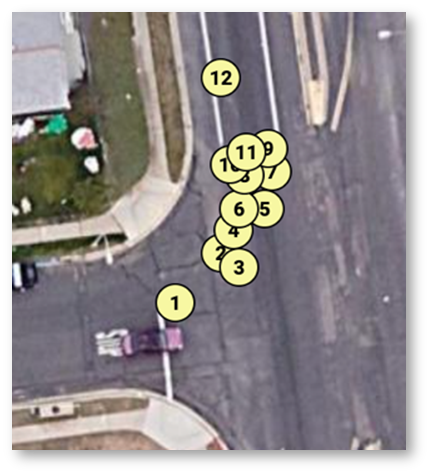
ShotSpotter map overlay with locations of gunfire, in order, indicating a possible drive-by shooting.
Initially, the Investigative Lead Summary (ILS) offers immediate access to date, time, approximate location, and incident audio links in the app and in the InSight historical database. The Detailed Forensic Report (DFR) is expedited in OIS situations, usually within 24-48 hours, and provides an expert, courtroom-ready analysis of shot timing, cadence, and location. In addition to the DFR, ShotSpotter forensic specialists can extract details that are particularly important in OIS investigations:
- Individual shot location and relative time: A pivotal question often arises: Did the suspect fire first, and if so, precisely when—relative to the officers’ response? ShotSpotter’s advanced acoustic sensor network captures audio evidence in real time, allowing forensic experts to dissect subsets of data for more precise results than the automated ILS. In the DFR, ShotSpotter experts lay out the timing and cadence of each shot to the millisecond, linked to the atomic clock for precise accuracy.
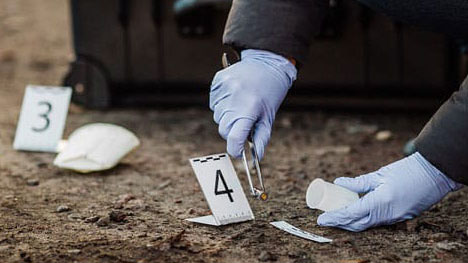
- Scene accuracy speeds evidence collection: Near-real-time alerts from the 24/7 Incident Review Center include the pinpoint location and number of rounds automatically detected. This essential information helps officers and technicians locate spent casings, projectiles, and other critical evidence at the scene, thus improving the preservation and collection of evidence.
- Accurate tally of rounds: Beyond timing and location, the accurate tally of rounds fired is a cornerstone of unraveling officer-involved shootings, which frequently involve multiple shooters. ShotSpotter forensic analysts can often access more audio files than the automatic capture represented by the ILS report, allowing them to locate audio pulses of additional rounds or nearby related gunfire. The resulting DFR provides this essential forensic detail.
- Potential shooter context: In the critical moments following gunfire, knowledge is power. ShotSpotter delivers instantaneously, tagging incidents with vital intelligence and relaying it directly to dispatch centers and mobile apps. Multiple Shooters, High-Capacity Firearm, Fully-Automatic Gunfire, and Drive-By Shooting (with mph and direction of travel) are some key real-time intel tags. In subsequent forensic analyses, ShotSpotter’s forensic experts rigorously verify and expand upon this data, delivering courtroom-ready evidence.
Documenting Ground Truth
The Ground Truth feature helps you close the loop between the alert and your case file:
Officers can log evidence at the scene. For example, number of victims, shell casings, or property damage are documented directly in the app. Supervisors and detectives are alerted immediately so casings can be fast-tracked to NIBIN or other testing without waiting for full paperwork.
Analysts and command staff can see Ground Truth status in InSight and generate reports, giving the agency instant visibility without digging through CAD or RMS entries.
On occasion, the 3+ required number of sensors do not detect the same gunfire. That may be due to the shooting occurring inside a vehicle or other closed space, the shooting happening just outside the designated coverage area, the use of small-caliber firearms or silencers, or environmental conditions interfering with the detection of gunfire.
To preserve the records for an OIS investigation, agencies must contact SoundThinking within 24 hours of gunfire that ShotSpotter did not detect. ShotSpotter technical staff will be able to determine whether any audio consistent with gunfire was captured. The 24-hour window is important as sensors automatically overwrite their data after 24 hours, only saving gunfire alert audio. Also important to note is that data from a shooting is automatically retained only if the requisite number of sensors captured the incident.
A practical checklist:

- Notify SoundThinking Support quickly of the OIS. Use the ShotSpotter app, or call, email, or chat with ShotSpotter customer support. Provide the incident address or GPS drop, date, and precise times. Request an expedited OIS DFR.
- Share agency identifiers. Case number, CAD/911 event numbers, and the lead investigator’s contact information.
- Confirm scene context. Note whether any shots may have been indoors, inside vehicles, or near reflecting surfaces. This helps analysts interpret or rule out acoustic anomalies.
- Preserve timing artifacts. CAD logs, AVL pings, BWC activation times, and radio timestamps help align the DFR timeline with other evidence.
- Retain the ILS for immediate use. The ILS is available from the app for 30 days, and from the ShotSpotter historical database, InSight, indefinitely. You can contact Customer Support for the ILS as well. Add the ILS to your case file so prosecutors can authenticate the existence of audio evidence while the DFR is being prepared.
For most OIS events, you can expect the DFR in 24–48 hours, which supports parallel administrative and criminal reviews, prosecutor intake, and early briefings to city leadership.
Start an Expedited DFR for an OIS Incident
Using Forensic Information for Investigation and Prosecution
ShotSpotter data is timestamped and objective, helping investigators establish timelines and other pertinent details during the OIS. This level of information, along with the receipt of the ILS and DFR, helps investigators and prosecutors with their assessment of administrative, civil, and criminal liability.
- Investigators and review boards can compare the shot-by-shot sequence against BWC, physical evidence, and statements to assess threat, movement, and compliance with policy.
- Prosecutors can use the ILS early to assess the audio of gunfire for how quickly an OIS unfolded. Later, they can use the DFR and expert testimony to support or challenge narratives, address self-defense claims, and meet evidentiary burdens.
Forensic Services Provides Clarity in the Courtroom
Jurors and judges respond well to objective timelines. Because each shot’s discharge time and location are calculated from multiple sensors, the DFR can show:
the sequence and spacing of rounds
whether shots came from the same or different locations
changes in firing position over time, which can inform assessments of threat, pursuit, or retreat
These points are developed by qualified experts who can testify to methodology and results, rather than limiting testimony to business-record authentication.
Use ShotCast to Communicate with Your Community
Officer-involved shootings place intense pressure on public information officers to share facts accurately and quickly. ShotCast™ is a built-in feature that packages verified information about a specific incident into a short video, including actual gunfire audio and incident details.
Agencies can export a simple MP4 that helps explain what happened, allowing the recording to add factual credibility to the narrative. And sharing carefully selected audio and location context promotes transparency and reinforces that the agency is releasing facts, not speculation, while still maintaining the integrity of the investigation.
Bottom Line
Throughout the course of an OIS investigation, time and trust are two currencies you cannot waste. For OIS incidents with corresponding ShotSpotter alerts, contact Customer Support via the ShotSpotter app, by phone, by email, or by submitting the Forensic Services form to request a Detailed Forensic Report. For shootings just outside a ShotSpotter coverage area or that otherwise did not result in a ShotSpotter alert, a quick chat, email, or call to SoundThinking can confirm whether acoustic evidence exists.
By integrating ShotSpotter’s precise sensor-derived locations and timings with traditional forensic evidence, investigators and prosecutors gain a clearer picture of what happened, resulting in a stronger foundation of evidence. With the support of data and Forensic Services in the courtroom, the acoustic evidence is detailed and objective. And agencies can leverage ShotCast when appropriate to demonstrate transparency and accountability, which can go a long way in a community reeling from an OIS incident.
Talk to an Expert about ShotSpotter and Forensic Services for Your Agency.
Was this article helpful?

Search for More Insights
Here are some other topics you might be interested in: