In May 2025, police responding to ShotSpotter activations in Homewood North located a gunshot victim and began rendering aid. The victim was transported to a hospital by emergency medical services (EMS) in stable condition.
ShotSpotter in Pittsburgh: Helping Police Respond Faster When Seconds Matter


When gunfire erupts, every second matters.
For police, EMS, and the community, the first few moments after a shooting can shape everything that follows. A faster response can help locate victims sooner, secure a scene more quickly, and preserve critical evidence before it disappears.
That is where ShotSpotter® has made a difference in Pittsburgh. As part of the city’s public safety response, ShotSpotter helps detect gunfire quickly, precisely identify its location, and send officers to the scene with greater speed and situational awareness. It is not a replacement for officers or community-based violence reduction efforts. It is an important technology in the police toolbox that helps first responders act faster when time matters most.
Faster Detection Can Mean Faster Help
One of the biggest challenges after gunfire occurs is that police do not know about it.
Independent research suggests 80% or more of gunfire incidents are not reported to 911. Sometimes callers hear shots but cannot say exactly where they came from. Sometimes people delay reporting because they are taking cover, helping others, or assuming someone else has already called.
Most times, though, nobody calls 911 after gunfire occurs.
That is where gunshot detection can make a difference.
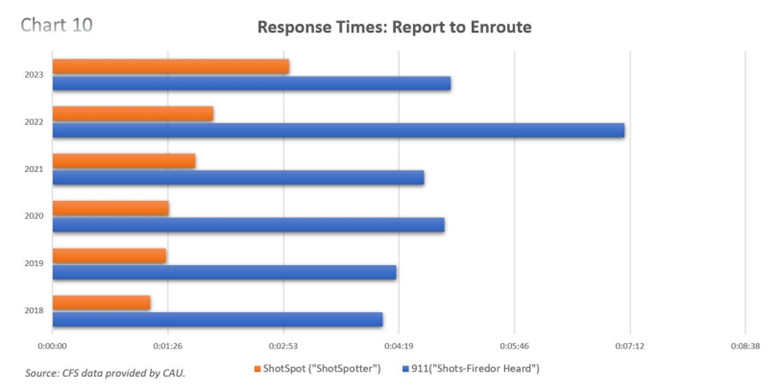
Even when a gunfire incident also prompted a 911 call, police response via ShotSpotter was significantly faster than the 911 call response. Between 2018 and 2023, both report-to-dispatch time and report-to-enroute time were about 63% faster for ShotSpotter alerts than for 911 calls, according to a City of Pittsburgh Controller report. In the critical moments after a shooting, that time matters. Faster dispatch and response times can help get aid to victims sooner and give officers a better chance of securing the scene quickly.
Pittsburgh’s Experience Shows Why Speed Matters
In Pittsburgh, the value of that faster response has shown up in life-saving ways.
WPXI reported that city data from 2019 and 2020 showed ShotSpotter was the only reporting mechanism that led first responders to 13 shooting victims over those two years. Five victims were found in 2019 and eight in 2020 without any 911 call being made.
The controller’s report found that Pittsburgh police moved significantly faster on possible gunfire incidents when alerts came through ShotSpotter rather than standard 911 calls. Using CAD/CFS data from 2018 through 2023, auditors compared two measures: the time from report to dispatch, and the time from report to officers going en route. Across that six-year period, both measures were faster with ShotSpotter. The report also notes an earlier internal police analysis that found a 67% decrease in response times, and the auditors’ own review supported the broader conclusion that ShotSpotter improves the bureau’s capacity to receive gunfire reports and get units moving faster.
Better Location Data Can Support Better Investigations
Speed is only part of the story.
When officers reach the right location quickly, they have a stronger chance of finding shell casings, damaged vehicles struck by bullets, and other evidence before the scene changes. ShotSpotter alerts provide a verified location of gunfire within an 82-foot radius, helping officers respond directly to the scene rather than losing valuable time canvassing a broader neighborhood.
That kind of location precision can make a meaningful difference for investigators trying to reconstruct what happened. It can reduce time spent searching unproductive areas and improve the chances of locating victims, witnesses, and physical evidence while the scene is still fresh.
Faster Response Times Equal More Life-Saving Measures
Pittsburgh police blotter reports help illustrate how ShotSpotter supports life-saving responses in the field.
Officers responded to multiple ShotSpotter alerts in Perry South in July, 2025. One victim was located with a gunshot to the back. That victim was transported by EMS to the hospital in stable condition. Shortly afterward, police found another gunshot victim, who was transported by EMS in critical but stable condition.
On August 9, 2025, police responded to a ShotSpotter alert in East Hills and located a juvenile female victim outside with a gunshot wound to her left calf. Officers began first aid until paramedics arrived.
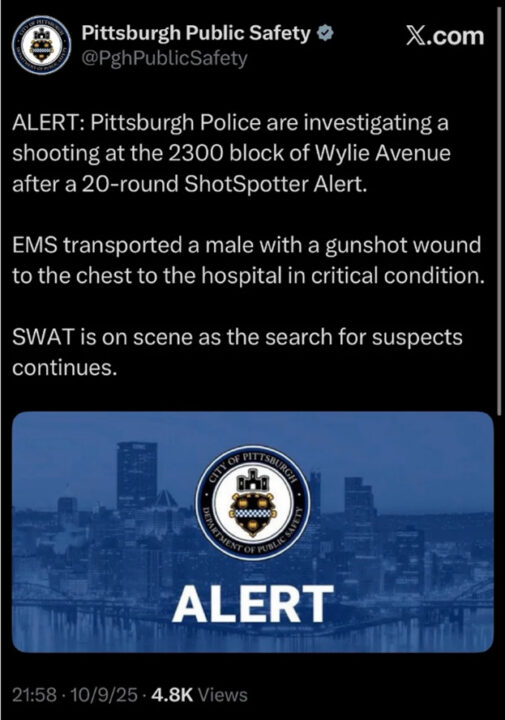
In October 2025, police responded to a ShotSpotter alert of gunfire in the 2300 block of Wylie Avenue, finding a male with a gunshot wound to the chest, who was transported by EMS in critical condition.
Officers responded to a ShotSpotter alert in Homewood North on November 18, 2025, and located an adult male suffering from a gunshot wound to the arm. He was taken to the hospital in stable condition.
Police responded to a ShotSpotter alert in Hazelwood on January 12, 2026, and found two damaged homes and shell casings. While clearing the first structure, officers located an adult female with a gunshot wound to the leg, who was transported in stable condition.
These incidents reflect the life-saving role ShotSpotter can play. It helps officers get to the right area faster, assess the scene more quickly, and begin lifesaving or investigative work much sooner.
A Stronger Tool in the Police Toolbox
No single solution can address gun violence on its own. But Pittsburgh’s experience shows that ShotSpotter can play a valuable role in a broader public safety strategy.
It helps officers respond faster. It helps first responders find victims when no 911 call is made. It helps investigators get to scenes sooner and recover evidence that might otherwise be lost. It enhances officer safety by providing critical situation awareness as they approach the scene.
For Pittsburgh police, that means a stronger operational response. For the Pittsburgh community, it means a better chance that help arrives when seconds matter most.
Was this article helpful?



Search for More Insights
Here are some other topics you might be interested in: