Who can access data
Community Engagement and Tech-Enabled Trust
Communities want public safety systems they can trust, not just because they include advanced technology, but because they use it responsibly, transparently, and in partnership with residents. As local governments adopt tools ranging from gunshot detection to advanced data systems, tech-enabled trust becomes a pressing issue. The real question is no longer “Should we use technology?” but “How do we use it in a way that builds trust rather than eroding it?”
Recent ACLU articles and other news sources report on what can go wrong when technology is deployed without strong oversight or limits. In one case, a widely used vehicle tracking platform allowed out-of-state agencies to access local driving records, included audit logs that were easy to bypass, and offered minimal contractual restrictions on data sharing. These practices created significant privacy and civil liberties concerns, especially for vulnerable communities.
This moment calls for a better model of public safety technology, one grounded in community engagement, privacy protection, and accountable design.
1. Technology Must Start with Engagement, Not Deployment
No public safety tool should be introduced without community involvement. Residents want a voice in understanding what the tool does, what problem it is intended to solve, what limits exist on its use, and how their rights are protected.
Meaningful engagement includes public meetings, stakeholder briefings, clear educational materials, and open feedback channels. When communities understand technology, they are more likely to trust it.
2. A Clear Purpose Creates Tech-Enabled Trust
Transparency begins with clearly communicating the technology’s purpose. For example, in the context of ShotSpotter, law enforcement leadership should be able to clearly communicate how the tool is designed to detect gunfire, locate victims faster, strengthen investigative capabilities, and reduce disparities in response times.
Purpose builds legitimacy. Ambiguity creates distrust.
3. Accountability Requires Strong Policies and Independent Oversight
Technology must be governed by clear, enforceable policies that define:
When the tool is used
What uses are prohibited
How long data is retained
When audits occur
How results are communicated to the public
Without formal policies, even well-intentioned tools can be misused.
4. Privacy Is Not an Accessory, It Is a Foundation
Residents have a right to know what data is collected, how long it is kept, who can access it, whether it can be shared, and whether the system can be misapplied
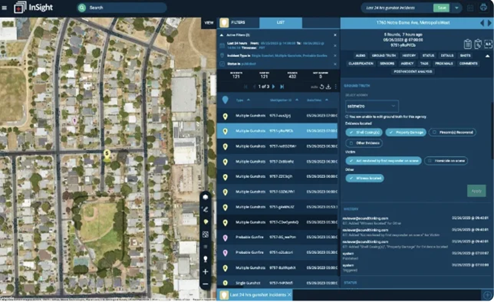
SoundThinking’s ShotSpotter technology incorporates privacy by design. Sensors are placed high above the street, typically on buildings or streetlights, to avoid street-level sounds. The system is tuned to listen for loud, impulsive sounds that sound like gunshots (e.g., gunshots or fireworks) and takes no action on other sounds, such as street-level sounds or human voices.
Additionally, the system features role-based access controls, auditable logs, and independent oversight. This stands in contrast to certain mass-surveillance tools that collect broad location information and share it across jurisdictions without strong privacy protections.
5. Oversight, Audits, and Transparency Sustain Community Trust
Trust is not built once. It must be maintained. Agencies should commit to regular independent audits, public summaries of audit findings, transparent reporting on system performance, clear accountability measures, and ongoing evaluation of equity impacts.
When residents see accountability in action, confidence grows.
6. Comparing Privacy Models Without Naming Names
Recent privacy controversies illustrate how the absence of guardrails can undermine public confidence. Some technologies in the industry have collected highly detailed location data and shared that data with numerous out-of-state agencies, created limited ability for residents to understand or challenge access, maintained audit logs that could be bypassed, and grown beyond their original purpose
These risks erode community trust.
SoundThinking follows a different approach. Its systems use a narrow purpose design, focus on public safety incidents, apply strict retention and access controls, and relies on independent audits and transparency reporting.
7. Engagement and Technology Create Community Resilience
Public safety technology is most effective when paired with transparent communication, clear policies, community feedback, privacy protections, and measurable outcomes.
When agencies show how the technology works and how it will not be misused, trust increases, and partnership becomes possible.
Delivering What Communities Want
Communities do not only want safety. They want fair and accountable safety systems, systems that protect without intruding, systems that support justice without undermining rights.
With transparency, accountability, and engagement at the core, technology can deliver exactly that.
Learn More About How SoundThinking Supports Tech-Enabled Trust
Was this article helpful?



Search for More Insights
Here are some other topics you might be interested in: