Obtaining CaseBuilder as a Case Management System for Orleans Parish Sheriff’s Office (OPSO) has been an upgrade that has been needed to move OPSO into future technology. The OPSO Investigation Division has been in a paper / EXCEL spreadsheet environment since its inception. Investigation documentation and evidence has been archived in numerous mechanisms. Since acquiring SoundThinking CaseBuilder, the OPSO Investigation Division now has a singular place for entry, research, tracking, and storing of evidence, in other words a ‘1-Stop’ place of reference. OPSO is now more efficient and compliant in our Investigations.”
How Technology Is Helping Louisiana Law Enforcement Protect Communities


Louisiana law enforcement agencies face the same complexities as those in many other parts of the nation: violent crime, persistent staffing challenges, and communities that expect both results and accountability. From rural parishes and smaller cities to the streets of Baton Rouge and New Orleans, chiefs, sheriffs, and their teams are under pressure to respond faster, investigate more effectively, and build public trust — often without additional personnel or funding to match the demand.
Increasingly, agencies across the state are turning to public safety technology not as a luxury but as an operational necessity. The right tools, deployed strategically, are helping Louisiana agencies detect crime sooner, manage investigations more efficiently, and deliver measurable outcomes that matter to the officers on the ground and the communities they serve.
Acoustic Gunshot Detection
In 2023, Louisiana had one of the highest gun death and gun homicide rates in the country. The leading cause of death for young people under 17 in Louisiana was firearms, and the age group of 15-34 accounted for nearly half of the total gun deaths in 2023.
When gunfire happens, most don’t realize that the vast majority is not called in via 911. Independent research suggests 80% or more of gunfire incidents are not reported to 911, which aligns with SoundThinking’s experience with ShotSpotter. So the very first order of priority is to use technology to understand where, when, and the magnitude of criminal gunfire in our communities.
ShotSpotter® is designed to close that gap by detecting gunfire and sending real-time alerts with precise locations so officers can respond faster, recover evidence before it disappears, and help save lives. With this awareness, law enforcement can shape a safe response, preserve important evidence, and turn a chaotic incident into a solvable case.
Baton Rouge news coverage shows what that looks like in practice. In an October 2025 shooting where more than 30 rounds were fired, local reporting stated officers were alerted to the scene “thanks to the ShotSpotter technology.” Another ShotSpotter alert in Baton Rouge led officers to the scene and shell casing evidence that assisted detectives in finding video from the scene, leading to an arrest. This is exactly the operational value chiefs care about: earlier awareness, faster response, a better chance of securing witnesses, shell casings, and video, and ultimately, accelerating justice.
The Challenge Is Clear in Louisiana — and Measurable
The pressures Louisiana law enforcement leaders face aren’t abstract — they’re measurable and can be extreme in some communities. According to 2024 data from the CSG Justice Center, violent crime rates in select Louisiana cities range from roughly 2.5 to more than 7 times the national average. Alexandria leads the state at 2,714 violent crime incidents per 100,000 population, followed by Monroe at 1,892 and Opelousas at 1,382. Shreveport, West Monroe, Bogalusa, New Orleans, Lafayette, New Iberia, Baton Rouge, Bossier City, and Natchitoches all exceed 890 per 100K — every one of them well above the national average of 359.
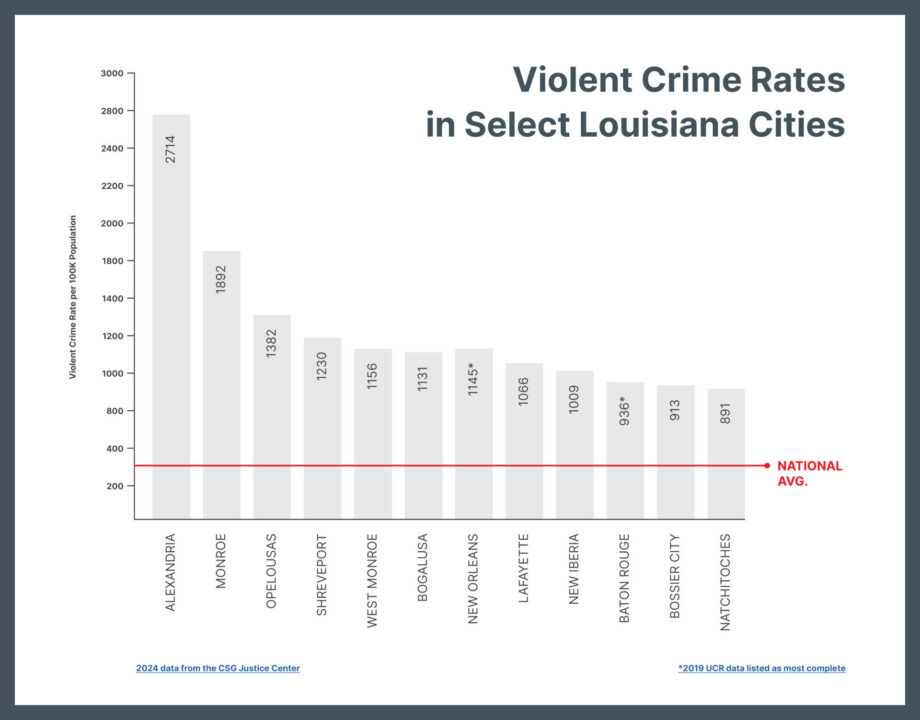
Importantly, these numbers aren’t an indictment of the agencies serving those communities. Chiefs and sheriffs across Louisiana understand the deeper socioeconomic factors, the generational challenges, and the resource constraints that shape these statistics. What the data does underscore is something every law enforcement leader in the state already knows: the demands on Louisiana agencies are disproportionately high, and the margin for inefficiency is razor-thin. When violent crime rates are two, three, or seven times the national norm, every delayed response, every lost piece of evidence, and every case that stalls due to administrative bottlenecks carries real consequences — for victims, for communities, and for the officers doing the work.
This is precisely where the right technology becomes more than an operational upgrade — it becomes a force multiplier for agencies that are already stretched to their limits.
Policing Technology Benefits the Community
The value of public safety technology extends far beyond the walls of a police department. When agencies invest in tools that improve response times, strengthen investigations, and increase operational transparency, the community feels the impact directly. Faster responses to gunfire mean victims receive medical attention sooner. Stronger case management means more crimes are solved, and offenders are held accountable. And when investigations are handled more efficiently, officers are freed up to focus on proactive, community-centered policing rather than drowning in administrative backlogs.
Transparency also plays a critical role in building and maintaining public trust. When agencies adopt systems that create auditable records, standardize workflows, and ensure accountability at every step of an investigation, they send a clear message to the communities they serve: We are committed to doing this work the right way. Orleans Parish’s move away from paper-based records toward a centralized investigative platform is a strong example of that commitment in action.
How can technology make investigations more efficient and effective?
Investing in tools to help make investigations more efficient is one way to do more with the same staffing levels. Data-sharing technologies like CrimeTracer™ Gen3 and CaseBuilder can help agencies replace spreadsheets and tracking investigations in Word documents on individual computers, making centralized information available to the right staff when they need it.
Orleans Parish implemented CaseBuilder in September 2024 and found that their investigations have been streamlined with increased operational effectiveness and enhanced transparency, where there was once concern about a risk of non-compliance with paper-based records and spreadsheets.
DIANA LEHMANN
Applications Analyst, Orleans Parish Sheriff’s Office
Agency Size Doesn’t Determine Technology Impact
One of the most persistent misconceptions in law enforcement is that advanced technology is only practical or affordable for large, well-resourced agencies. The reality is that technology benefits agencies of all sizes. Smaller and mid-sized agencies across Louisiana frequently stand to gain just as much from adopting the right technology solutions, precisely because they work with tighter budgets, leaner staffs, and fewer specialized units.
For a large metropolitan department, adding a technology platform may represent an incremental improvement layered on top of existing infrastructure and dedicated personnel. For a smaller agency where one detective may be managing dozens of cases simultaneously, patrol officers are covering vast jurisdictions with minimal backup, or administrative staff wear multiple hats, the right investigative, analytic, or patrol management tool can be transformational. The challenge for all agencies is finding the right technology tools within allotted budgets that are often stretched thin.
Technology Can Make a Large Impact
The evidence from agencies already leveraging these tools across Louisiana is clear: public safety technology works. ShotSpotter alerts are leading officers to gunfire locations and recoverable evidence in Baton Rouge, New Orleans (pilot), Monroe, and more than 170 other jurisdictions nationwide and globally. CaseBuilder’s centralized case management is replacing fragmented paper trails, strengthening investigations, and enhancing accountability in Orleans Parish. And agencies of every size beyond Louisiana are discovering that the right investment in technology delivers returns that extend into stronger officer safety, safer neighborhoods, and deeper community trust.
Ultimately, the question Louisiana law enforcement and community leaders should be asking is not whether their agency can afford the right technology investment. It is whether they can afford not to make one. When every officer, every hour, and every dollar counts, technology is the multiplier that allows agencies of any size to protect their communities more effectively.
Schedule a meeting at the Louisiana Chief Conference, March 3-5, 2026, to learn more.
Was this article helpful?



Search for More Insights
Here are some other topics you might be interested in: