Roughly 90% of gunfire incidents would have gone unreported without ShotSpotter, as only about 10% of alerts had a corresponding 911 call.
CSU Findings Affirm ShotSpotter’s Accuracy and Value


The City of Cleveland commissioned Cleveland State University (CSU) researchers to conduct a two-year evaluation of the Cleveland Division of Police’s (CDP) use of ShotSpotter technology. This independent study (“Evaluation of Cleveland Division of Police’s Implementation of ShotSpotter”), published in August 2025, showed that ShotSpotter consistently performed as designed: it accurately detected and located gunfire, alerted police within seconds, and helped officers reach victims and evidence faster, ultimately saving lives that might otherwise be lost.
Conducted from Summer 2023 through Summer 2025 across all five police districts, the evaluation offers an important, data-driven look at how acoustic gunshot detection operates in real-world conditions. Despite the operational challenges the researchers identified in Cleveland’s broader public-safety environment, the study makes clear that ShotSpotter itself functioned as intended and delivered on its promise to the City of Cleveland.
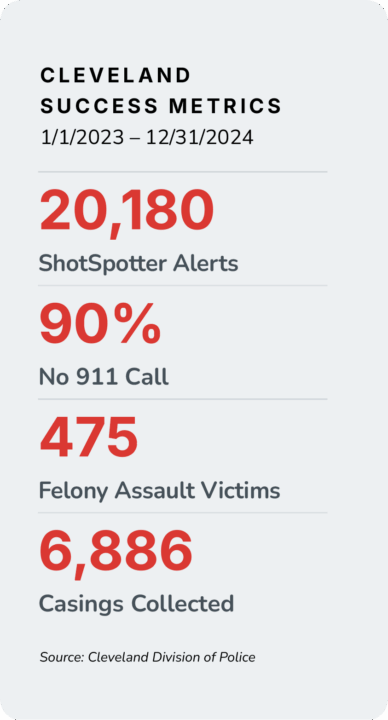
1. The CSU study affirmed ShotSpotter’s effectiveness.
In the study, researchers found that the technology operated as intended:
The technology accurately identified and located gunfire.
Alerts were more precise than 911 calls, allowing officers to respond faster – within seconds.
Officers administered life-saving aid in 53 incidents connected with ShotSpotter alerts.
2. The CSU researchers identified operational capacity, not technology, that limited Cleveland’s ability to take full advantage of ShotSpotter.
The study emphasized that the main barriers to maximizing ShotSpotter’s impact were capacity-driven. The researchers cite:
Staffing shortages. CDP experienced the steepest percent decline in officers from 2019 to 2024 among comparable U.S. police departments, which “severely limited” its ability to respond to the increased volume flagged by ShotSpotter.
Workflow constraints. Existing workload demands and system-integration hurdles restricted how often officers could use ShotSpotter’s full suite of forensic and analytical tools.
Resource gaps. The report noted that ShotSpotter delivered faster, more accurate responses and that the primary challenge was a “dearth in human resources.”
Importantly, the researchers did not recommend discontinuing ShotSpotter. Rather, they highlighted that CDP’s limited personnel and duplicative data-entry demands constrained its ability to take full advantage of the system.
3. Researchers found that Cleveland’s deployment choices, not ShotSpotter’s capabilities, limited integration with other technologies.
The CSU researchers noted that ShotSpotter was difficult to integrate with other kinds of policing technology in Cleveland. However, the report makes clear that this difficulty stemmed from Cleveland’s specific deployment context.
Nationwide, ShotSpotter integrates broadly with computer-aided dispatch (CAD) systems, real time crime centers (RTCCs), CCTV platforms, license plate reader (LPR) networks, drones, mapping tools, and analytics systems through open application programming interfaces (APIs). This includes integrations with FUSUS in more than 40 agencies nationwide, as well as systems already used by CDP, such as its RTCC platform, Hexagon CAD, and Motorola Solutions’ AWARE.
4. The study recommends increasing CPD staffing and training to realize the best results from acoustic gunshot detection deployment.
Far from criticizing ShotSpotter for its effectiveness or accuracy, the researchers’ most significant takeaway was that CDP was not properly staffed:
“Current staffing levels are not sufficient for the Cleveland Division of Police to improve its use of ShotSpotter going forward.”
The researchers advised adding personnel to manage alerts and data, expanding officer training, and improving internal communication and community education on how the technology works.
Summary
Overall, the CSU evaluation affirmed that ShotSpotter works as designed but understates the broader impact. ShotSpotter ensures virtually all criminal gunfire is detected, victims receive medical assistance as needed, and law enforcement collects vital evidence that otherwise would be lost. Equally important, by enabling rapid, comprehensive response to gunfire, communities know their safety is a priority, which helps build trust with CDP.
Finally, while no single technology or tool can solve the scourge of criminal gunfire and gun violence, ShotSpotter remains a proven component of a modern, evidence-driven public safety strategy used in more than 170 cities across the country and internationally.
Contact us to learn more about ShotSpotter
Was this article helpful?




Search for More Insights
Here are some other topics you might be interested in: