











Gang investigations are not a numbers game — they’re a network game. Research out of San Diego found that about 35% of the gang-affiliated arrestees surveyed reported working with other gangs for profit. Not only is one gang network large and unwieldy to track, but the connections and links between one or more gangs can be even harder to pin down. But finding, mapping, and dismantling the relational network around a criminal enterprise can have an outsized impact on violence in a community.
The challenge is that most investigative tools aren’t built for network-level thinking. They’re built for individual cases. And when gang activity spans multiple jurisdictions, document types, and data sources — as it almost always does — investigators are left manually connecting dots across systems that were never designed to talk to each other.
That’s where CrimeTracer changes the equation.
Gang Violence by the Numbers
The FBI’s Gang Activity, 2021–2024 report, released in September 2025 and based on NIBRS data, shows from 2021 to 2024, law enforcement reported nearly 70,000 gang-related incidents nationwide. More than half involved murder, aggravated assault, rape, or robbery. Weapons were present in 80.4% of incidents, and aggravated assault accounted for the largest share of offenses at 39.4%.
What’s striking about the data is who’s involved. The report showed 67.1% of victims knew their offender in some way. Gang violence isn’t random. It’s relational. It concentrates around specific networks of people with known connections to one another, and it repeats along those same networks until someone disrupts them. Understanding and mapping those connections is the core of effective gang investigation — and it’s exactly what investigators lack the tools to do at scale.
The Data Problem That’s Undermining Investigations
A 2025 study from Northeastern University’s Network Science Institute put it bluntly: missing and inconsistent data render gang investigations difficult and often ineffective. The researchers analyzed criminal network datasets, including a London juvenile gang and a New York cocaine trafficking ring, and concluded that “data incompleteness is a significant threat to both the intelligence and implementation phases of network disruption missions.”
The problem isn’t a lack of data. It’s fragmentation. Every agency records what it knows differently. Patrol officers capture field interview cards in one system, and bookings land in another. Court records, LPR hits, and warrant data each live in different places. A detective in one jurisdiction may have no idea that the suspect they’re building a case on has a known gang affiliation, a prior weapons arrest, and three active addresses across one or more county lines.
As the researchers put it: garbage in, garbage out. Decentralized gangs with loosely based central figures are harder to define with less data. And even centralized gang networks can be difficult to link across multiple jurisdictions and data systems. Having access to large amounts of data from multiple sources helps investigators see the full network, not just the portion from within their jurisdiction.
Data and Patience: When the Suspect Goes Dark
Sometimes the network doesn’t reveal itself right away. In 2019, Cobb County, Georgia, investigators caught one suspect in a homicide shortly after the crime, but the driver disappeared. A year passed. During trial prep, investigators turned up a phone number that might have belonged to the missing suspect.
A CrimeTracer™ search on that number surfaced something Cobb County had no way of knowing on its own: the suspect had filed a vehicle report in Los Angeles, more than 2,000 miles away, just five days after the murder. That single cross-jurisdictional record gave investigators what they needed to locate and extradite him. Both suspects were convicted.
For gang units, this is the same problem in a different wrapper. A suspect who goes quiet in one area rarely stays off the grid everywhere. They show up in a traffic stop, a field interview card, or a report filed three states away. The breadcrumb exists. The question is whether the tools your agency uses can see across the jurisdiction line to find it.
From One Connection to a Network: How CrimeTracer Works
CrimeTracer is a law enforcement intelligence platform that searches more than 1 billion records from agencies nationwide, searching over 40 document types, including RMS, CAD, LPR data, ShotSpotter incidents, jail bookings, court records, pawn tickets, field interview cards, warrants, and more.
For gang investigations specifically, the platform goes well beyond a traditional database search.
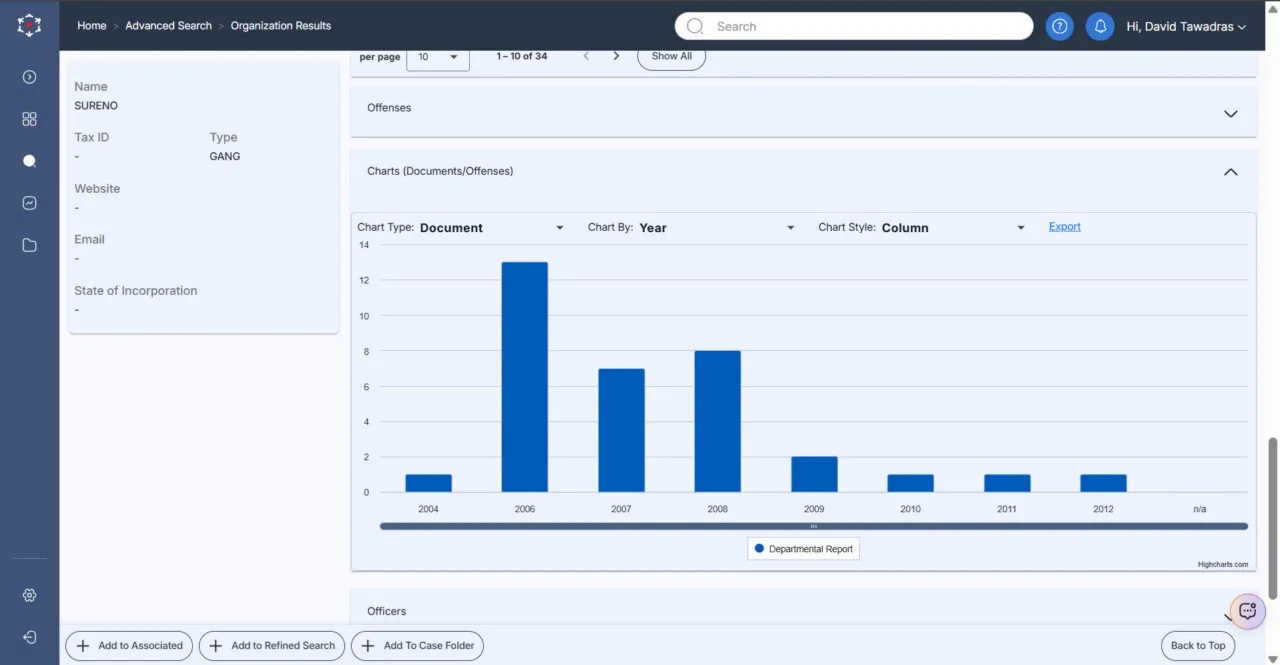
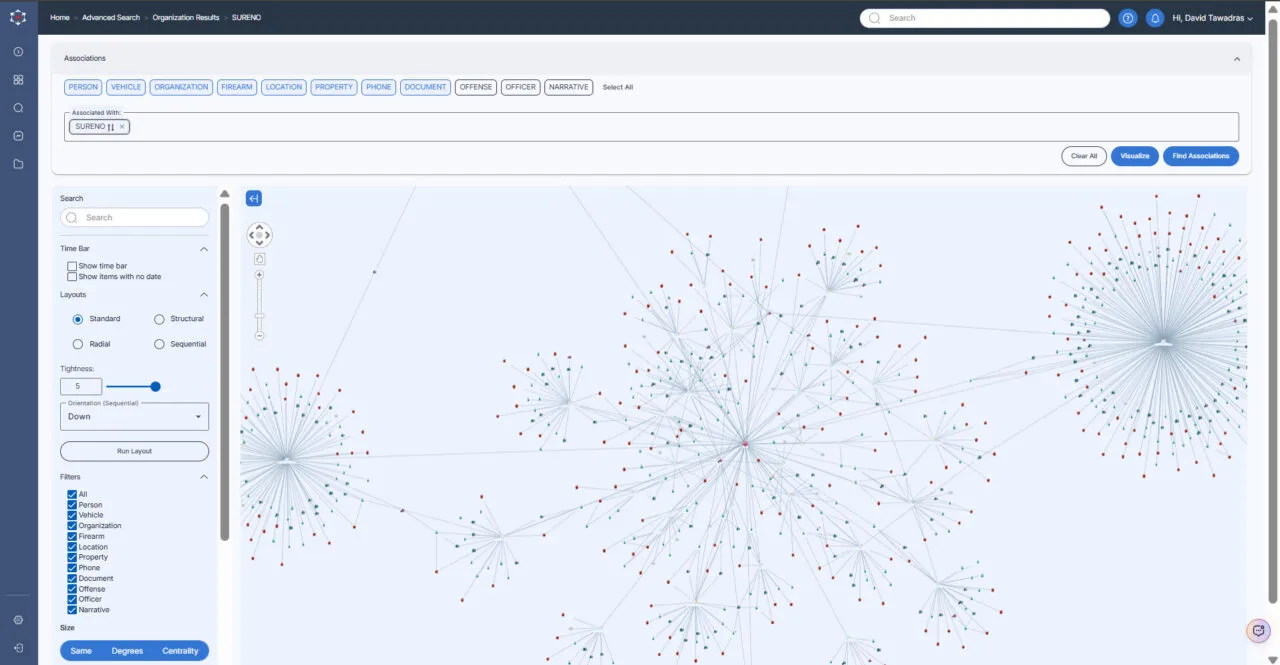
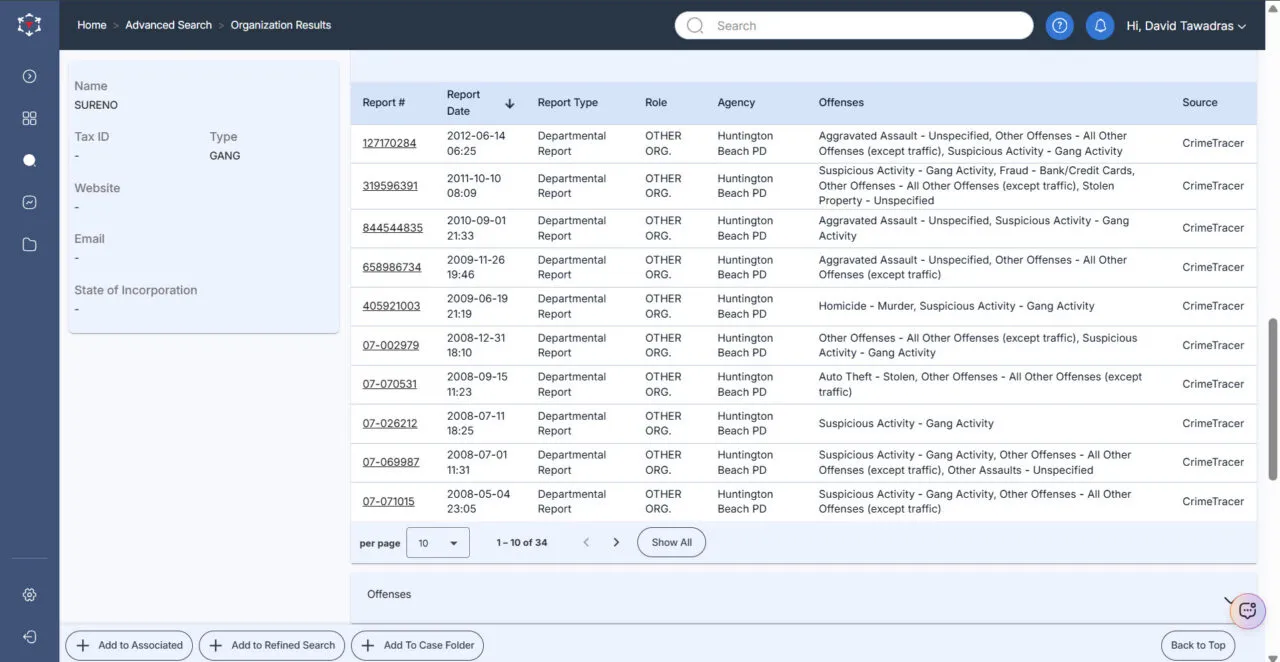
- Search by gang name and association: Investigators can search directly by gang name, surfacing every connected record in the database — arrests, addresses, known associates, vehicles, firearms, and incidents — regardless of which agency originally entered the data. A single search can reveal a network that spans multiple jurisdictions and years of criminal history, consolidated into a single view.
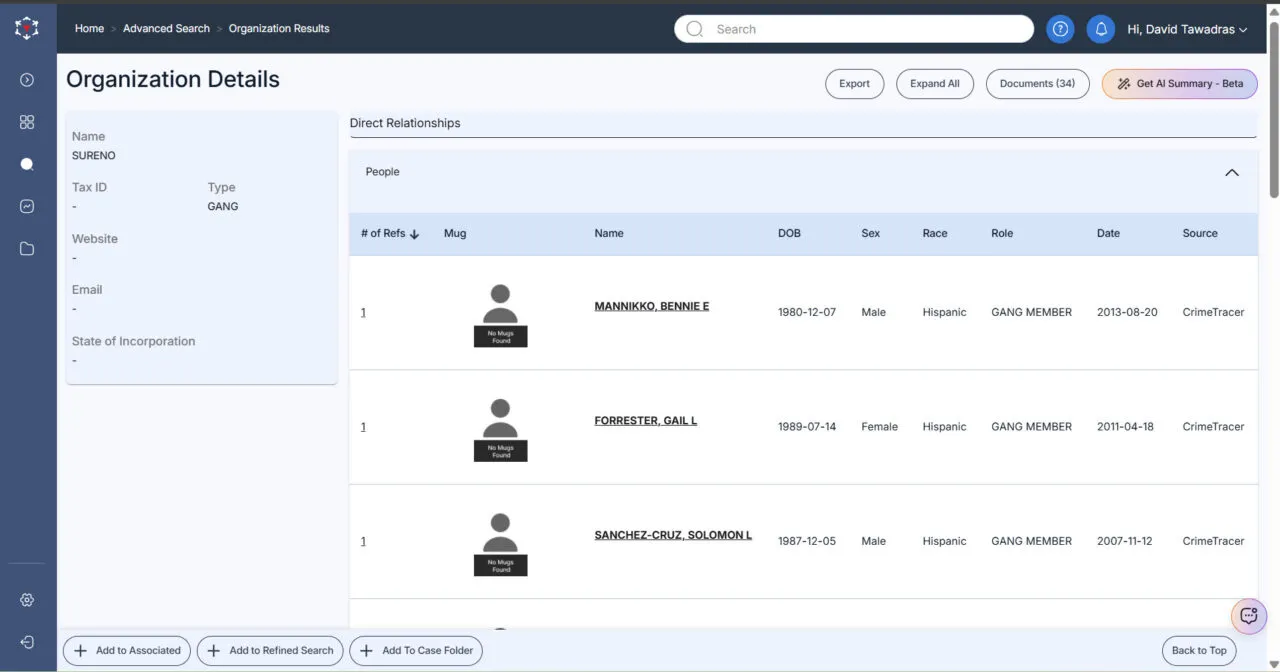
- Link analysis that maps the whole network: CrimeTracer’s link analysis and Visualizer tool transform data into a relational map. Each person, vehicle, location, or organization becomes a node. Their connections become links.
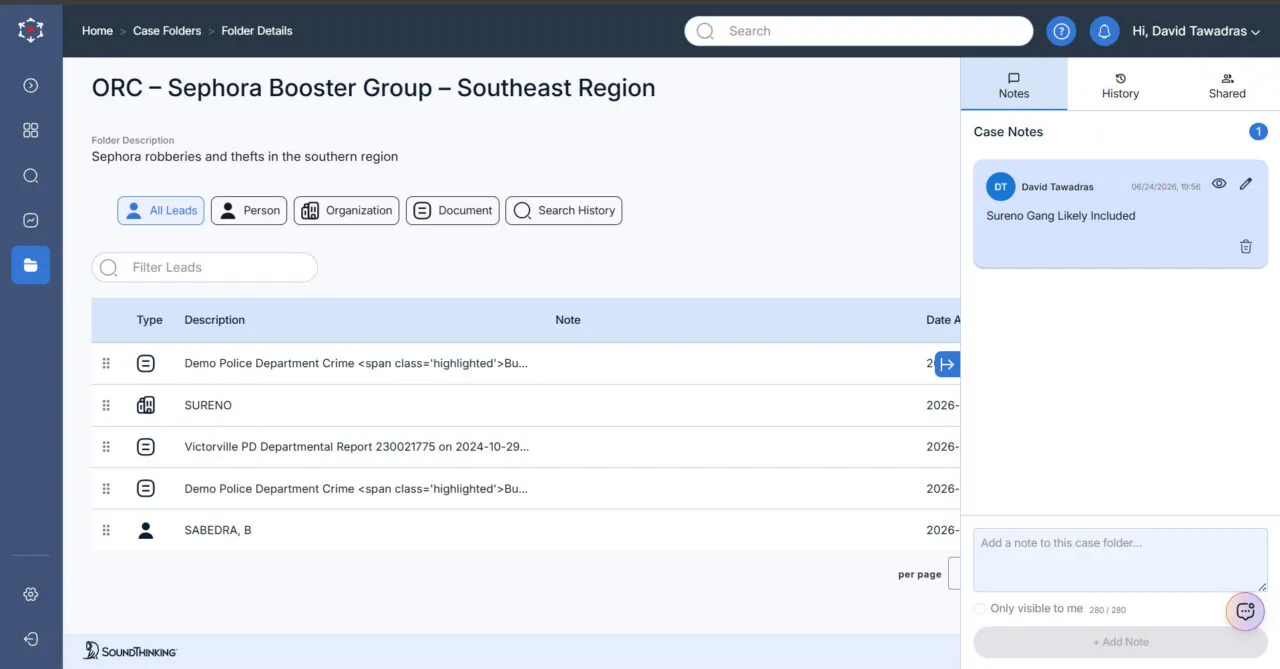
- Case Folders: CrimeTracer’s Case Folders give investigators one workspace to pull together every person, vehicle, location, and document tied to a gang case, so the full network stays visible. Case Folders can be shared with other authorized CrimeTracer users, making it faster to brief a task force or share a large case across an agency or multiple jurisdictions without losing the connections that took weeks to build.
Cross-jurisdictional vehicle intelligence
Because motor vehicles are involved in more than 75% of all crimes, vehicle intelligence is central to gang investigations, not supplemental. When PlateRanger ALPR data is integrated with CrimeTracer, investigators can instantly surface:
- Prior incidents connected to the vehicle or its frequent locations
- Known associates who were in the same car during past stops
- Cross-jurisdictional matches where the vehicle appears in gang-related warrants or arrests
- Unknown prior involvements — citations, traffic stops, field interviews — that build a fuller picture
- Alerts for any new plate reads on a flagged vehicle, delivered in real time
Wildcard plate searches let investigators work from partial plate numbers, filling gaps that traditional DMV queries can’t bridge.
When Data Becomes Actionable Intelligence
Gang cases are long-running and complex. CrimeTracer’s case folder functionality keeps all related incidents, leads, records, and associate profiles organized in one place — so as the investigation grows, investigators aren’t starting from scratch every time they come back to it.
For gang unit investigators, that’s a meaningful shift. Gang members are increasingly aware of surveillance — they adapt. But the breadcrumbs they leave behind across jurisdictions, data sources, and vehicle records are harder to erase. CrimeTracer’s value is in connecting those breadcrumbs into a coherent picture.
If your agency is managing gang investigations across siloed data sources and struggling to build network-level intelligence, CrimeTracer was built for exactly that challenge.
Schedule a demo to see how CrimeTracer can support your gang unit’s investigative workflow