Threat Assessment
Technology: Tools like gunshot detection, weapon detection, drones, license plate readers, and mass notification systems can save lives when paired with robust policies and effective training.
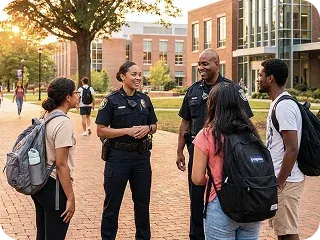
As a mother of a college student, I view campus life through a unique lens. For decades, I dedicated my career to service as both a law enforcement officer and a university police chief. On campus, I worked to create and sustain safe, secure, and welcoming environments for students, faculty, and staff. My efforts focused on prevention, preparation, and protection. Today, my view remains deeply personal. My son roams across the quad, attends lectures, and lives within a campus community very similar to the one I once worked hard to protect.
I dedicated my life to ensuring safety, most recently serving as a campus chief. I’ve observed how campus safety has evolved. The responsibilities of campus police and public safety teams extend beyond traditional law enforcement. Threat assessment, emergency management, mental health collaborations, and crisis communications all play a vital role in this environment of intense learning and deeper understanding.
Threat Assessment
Emergency Management
Campuses are intentionally designed to foster a sense of community and encourage innovation. This complex dynamic makes them susceptible to internal and external threats. At the same time, students and their families expect not only safety but also transparency and accountability in how universities prepare for and respond to threats and crises.
The evidence of these vulnerabilities is too often in the news. The rise of targeted violence, concerns about gun safety, and the need for rapid communication have become top priorities and drive unprecedented demand for modern solutions.
On the job, I grew accustomed to measuring safety using data points such as response times, crime rates, trends, and community engagement figures. But as a mother, I realize that true safety is less concrete. Peace of mind can’t be measured.
I find myself wondering, “Can my son walk across campus without worry? Will he feel prepared if there’s an emergency alert on his phone? Does he trust the institutions I once led to protect him and his classmates?”
Every parent struggles with these questions, especially when news of the latest campus shooting dominates the news cycle. These worries are real. Little did I know the fears that haunted me would soon become reality. I thought I understood what fear felt like, until the day I received an active shooter alert from my son’s university. In that moment, every professional instinct I had honed over decades collided with the helplessness of being a parent hundreds of miles away. I knew the protocols. I trusted the training. But none of that prepared me for the agonizing silence while waiting to hear if my son was safe.
That moment changed me. It stripped away every layer of professional detachment and reminded me that behind every campus safety policy, every emergency notification, and every security system are real lives, students, parents, faculty, and first responders, each experiencing the ripple effects of fear and uncertainty.
As leaders in public safety and education, we can no longer treat these incidents as isolated events. They are part of a broader challenge, one that demands preparation, communication, and compassion in equal measure. Campus safety isn’t just about response; it’s about readiness, resilience, relationships, and, for me in my new role, currently, passion. Thankfully, opportunities for innovation and stronger partnerships provide solutions and solace.
The path forward requires courage, collaboration, and investment:
Technology: Tools like gunshot detection, weapon detection, drones, license plate readers, and mass notification systems can save lives when paired with robust policies and effective training.
Prevention: Threat assessment teams are continually evolving. We must work together to identify risks before they fester into bigger issues.
Trust: Transparent communication and genuine engagement with students and families remain critical. Campuses must go beyond just locks and cameras.
Holistic Safety: True security also means addressing students’ mental health, inclusion, and overall well-being.
As a former university chief, I understand the importance of safeguarding a campus community. As a mother, I hold the daily expectation that my son and every student will thrive in an environment where safety is the foundation for learning and growth, not an afterthought.
This requires difficult conversations and continuous assessment. Campus safety is no longer just a professional duty for me; it has become personal and urgent. A passion that is flanked by a deep sense of purpose and motivation. It is what drives me to go beyond what is required, not because I have to, but because I want to. The time to act is always now.
Schedule a Demo to See How SoundThinking Can Protect Your Campus