972,242 incidents created – Three or more sensors detected the sound, the system located it, and an incident was created.
SoundThinking’s Approach to Fourth of July Safety

Distinguishing gunshots from fireworks: At SoundThinking, the Fourth of July is more than an important national holiday celebrating our independence.
Hidden amidst the millions of fireworks explosions across the country is the deadly sound of illegal celebratory gunfire, which, combined with other types of gunfire, shatters lives and impacts communities. Fourth of July safety is a top priority, and we know that our ShotSpotter® alerts help police and first responders save the lives of gunshot victims. That is why, on our busiest days of the year, we roll up our sleeves and put our technology and people power to the test—to sort through millions of bangs, booms, and pops—and alert our customers to incidents of real gunfire.
Let’s start with some statistics to show the scale of our operation during this time of year (July 4-5, 2025):
- Nearly 862,000 incidents filtered out by our machine classification algorithm – Dismisses incidents whose characteristics are not consistent with gunshots.
- Just over 110,000 incidents were sent to our Incident Review Centers (IRC) – where human reviewers analyze each incident to determine if these incidents were gunshots or not.
- 2,117 incidents published – Gunshot alerts sent to law enforcement customers.
- 94% of incidents were published in under 60 seconds – The amount of time between review and alert being sent to the law enforcement customer.
Let’s consider those statistics for a moment. The powerful machine-learning filtering algorithms accurately dismissed more than 89% of the incidents as sources other than gunfire. This allowed our trained IRC analysts to discern the small number of gunshots (2%) from over 110,000 incidents, even though many occurred in a short time. Talk about finding a true needle in a haystack in a situation where every second counts, pressure is high, and human lives are at stake.
How We Did It
ShotSpotter uses an array of acoustic sensors that are connected wirelessly to a centralized, cloud-based system that reliably detects and accurately locates gunshots. Each acoustic sensor captures the precise time and audio associated with impulsive sounds that may represent gunfire, enabling the system to use the data to calculate precise time and location via multilateration.
In near real time, the system creates an image mosaic that represents the sound characteristics of the noise event, along with various details about the incident, such as the set of sensors that detected it. The resulting image mosaic is analyzed by a machine learning algorithm trained with gunshot and non-gunshot incidents collected over 25 years of real data to filter out incidents that are clearly not gunshots.
Within seconds, the remaining incidents (potential gunshots) are relayed to our expert analysts at our IRC, who have been extensively trained to analyze the sounds and visual patterns of gunfire from other sounds. They replay the sounds from multiple sensors and view the waveforms. For example, gunfire tends to have a steady cadence with pulses of equal strength and sound, whereas firecrackers are more sporadic with overlapping pulses of differing strength and sound.
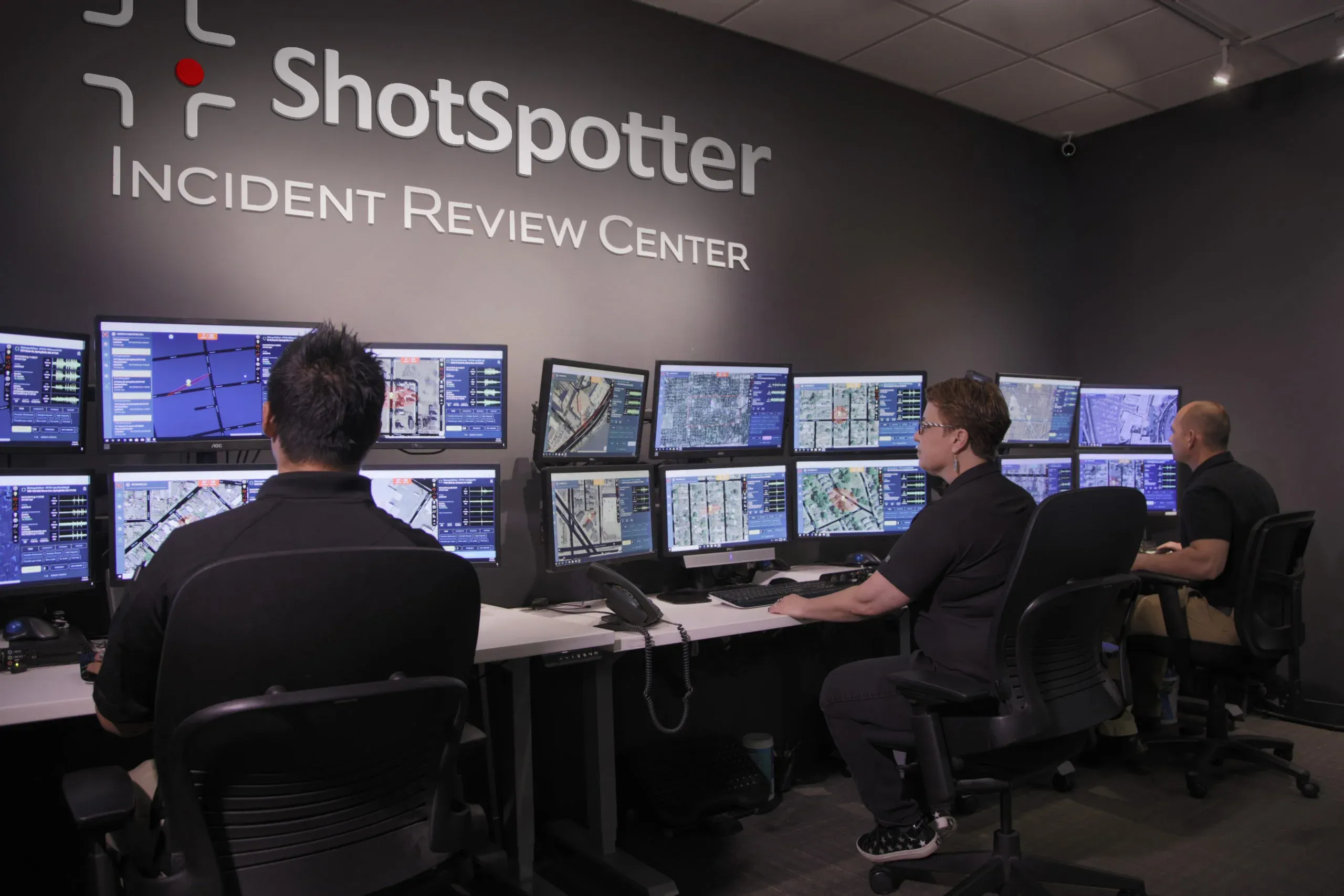
The Incident Review Center
Reviewers also take the intensity of each pulse into their analysis. This is because fireworks often produce a small bang followed by a loud bang. Multiple shots fired from a single gun have similar intensity and loudness—around 140 decibels in the case of a handgun. By analyzing the waveforms and listening to the sounds, human reviewers make the final decision whether to publish an alert to law enforcement or dismiss it as a non-gunshot.
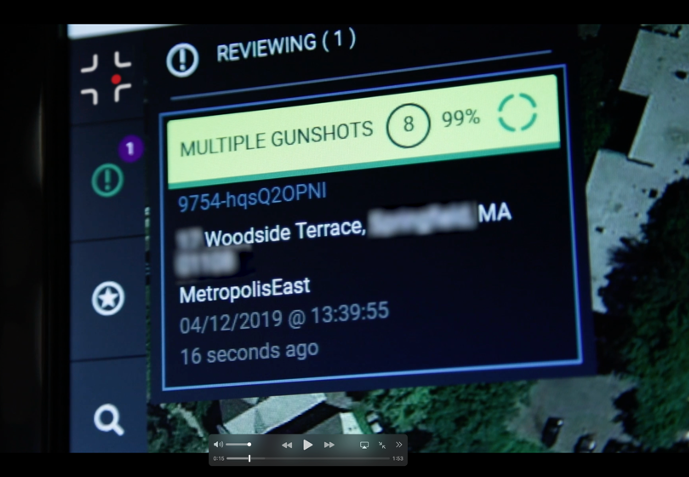
The published alerts include the incident’s latitude and longitude, the time of the incident, and the round count, all as detected by the system. With the real-time alert, ShotSpotter provides a map where the gunfire is located. We also provide the nearest street address, based on the system’s automatic reverse geocoding of the latitude and longitude.
Extensive analysis, scaling, and planning are conducted in preparation for the Independence Day festivities. To maintain Fourth of July safety in the cities we support, we add staff for those shifts, given the higher number of incidents to review in a short period. Various technical teams also carefully monitor hardware, software, and system performance metrics.
What This Means for Our Technology and Company
On a day like the Fourth of July, when our system registers millions of booms, pops, and bangs, this can be challenging, a “stress test” of sorts for our systems and expert human analysts. During the Fourth of July holiday, our system experienced a higher volume of incident activity over a longer period. That takes resilience, both in our technology and in our staff. Yet our commitment to maintaining Fourth of July safety through accurate, near-real-time alerts remains unwavering.
It is important to take a moment to recognize how we got here. Let’s start with our technology. Our highly sophisticated algorithms are the product of years of investment and refinement by our talented team of engineers. Our technological advancements—just like our reputation as the foremost leader in gunshot detection—did not happen overnight, and we could not be prouder of our ground-breaking achievements.
The same can be said for our highly trained analysts in the IRC, many of whom possess years of experience in this field. Even on days like the Fourth of July, we hold them to high standards, 99 percent accuracy in fact, and they, too, are essential to our continued success.
We often say here at SoundThinking that we are proud to do “work that matters.” This is especially true on holidays like the Fourth of July, when SoundThinking’s people and systems are tested. Through it all, we stand committed to the agencies we serve by filtering out the high volume of fireworks sounds and remaining steadfast in our efforts to publish thousands of gunfire alerts to help law enforcement respond more effectively to shootings in their communities and maintain Fourth of July safety.
Was this article helpful?



Search for More Insights
Here are some other topics you might be interested in: