Comprehensive Crime Data Network with CrimeTracer and Peregrine

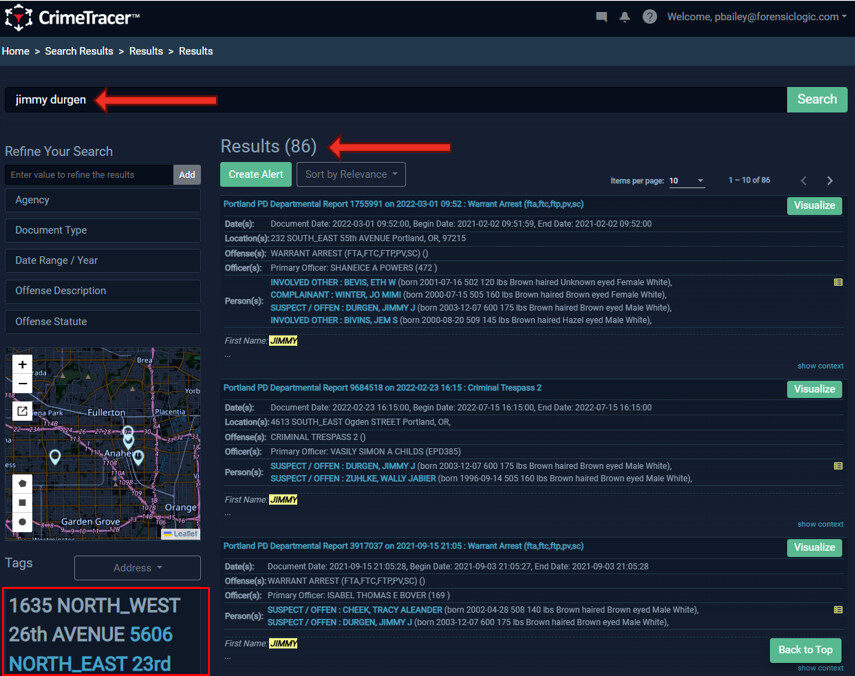
Investigators need answers fast, and those answers live in more than one place. CrimeTracer™ is the intelligence network that connects the dots, using advanced algorithms to link people, vehicles, and places and turn records into leads. Peregrine is the city-wide data repository that lets a user run a single search across multiple systems.   CrimeTracer works best for criminal insights and investigations. Peregrine is useful for operational insights.

 A connected city has more data than ever. Yet crime often spans cities, counties, and even states. And oftentimes, analysts still link people, vehicles, and places by hand. Detectives still lose the trail at the city line. Patrol officers still need answers in seconds. CrimeTracer searches across multiple jurisdictions—cities, counties, states, and other records—giving investigators connections and stronger leads. An intelligence network like CrimeTracer fills these investigative gaps.

Agencies looking to strengthen their investigative technology typically want systems that:

•        Quickly connect disparate data across multiple systems and jurisdictions.

•        Show a single person's involvements in one view, regardless of how each record was entered or which systems hold it.

•        Put the latest information on patrol areas in patrol officers' hands quickly, improving situational awareness and officer safety.

•        Support collaboration with other users and agencies on large cases, such as organized retail crime (ORC) thefts.

•        Reveal associations and links in depth to uncover the needle in the haystack.

•        Let investigators and officers retrieve information and run link analysis independently of crime analysts.

•        Integrate with other law enforcement systems and software, such as RMS, DEMS, license plate recognition (LPR), and case management software.

No single product covers all five equally well. Pairing a city-wide data repository with an intelligence network does, making CrimeTracer a complementary solution to Peregrine.
See How CrimeTracer's Crime Intelligence Network Can Help Your Agency

Book a Demo

What a City-Wide Data Repository Does Well

Peregrine provides data management solutions for law enforcement and public safety agencies. Its platform pulls records from across a city’s systems into one place, so users run a single search instead of logging into each system separately.

That shared foundation matters. Departments work from the same data. Secure information sharing gets easier, collaboration improves, and workflows move with fewer handoffs within and across departments. For an agency building a connected approach to public safety, a repository is a strong place to start.

A repository shows an investigator what the city already holds. An intelligence network connects the people, vehicles, and places inside those records, while searching across jurisdictions and public data sources like NDEx.

What an Intelligence Network Adds

CrimeTracer, formerly recognized as COPLINK X, is an intelligence network built to connect the dots and solve crimes. Advanced algorithms and artificial intelligence search a very large body of records to surface relationships and leads that manual searching can miss.

The records reach well past a single city. CrimeTracer gives investigators access to more than 1 billion CJIS-compliant records from over 2,100 agencies. The National Data Exchange (N-DEx), the Law Enforcement Information Exchange (LinX), and the Thomson Reuters CLEAR database of public records add to that reach.

CrimeTracer uses AI, including natural language search, to return relevant results that speed up investigations. It generates link charts that show relationships between people, vehicles, and other entities found in records. It also maps crime patterns in specific areas, giving command staff, investigators, and the communities they support a clear view of what is happening where.

CrimeTracer puts these capabilities in the hands of everyone from patrol to investigators and detectives to analysts and up to command staff. It adds Patrol and Trends Dashboards, a voice-enabled natural-language search Chatbot, AI Summarization, Case Folders that can be shared with alerts notifying users of newly added records, and clear Entity Summaries. Scattered data becomes decisions.

CrimeTracer Gen3 has become essential to how we build workups. It pulls together the information officers and detectives need in one place.

Brittany Dyer

Tactical Crime & Intel Analyst, Tempe Police Department

How CrimeTracer and Peregrine Work Together

The two solutions split the work. The city-wide repository gives investigators one search across local systems, so prior calls, reports, and records tied to a person, such as an address or vehicle, come back together. CrimeTracer then connects this information to other cases, other people, places, and vehicles, and analyzes their relationships, even uncovering leads across jurisdictions, including records held by agencies outside the city.

  •  Each solution does a different job - A repository unifies access. An intelligence network generates leads. Cities that treat these as an either/or decision end up with a gap on one side. Treating them as two jobs closes both.

  • Crime does not stop at the city line - Suspects, vehicles, and warrants move across county and state lines. A city-wide repository covers the city. CrimeTracer covers the trail beyond it.

The investigator gets the full local picture and the connections that turn it into a suspect. When leads become suspects, CrimeTracer creates crime bulletins in the same workflow, which reduces time spent moving between systems.

Five CrimeTracer Capabilities That Turn Scattered Data into Intelligence

Key Feature # 1: Generate Investigative Leads Quickly Through Multiple Databases

Effective investigations depend on strong leads and the right tools. With over two decades of proven investigative impact, CrimeTracer’s longevity means the platform has been iteratively hardened in real-world investigations, court proceedings, grand jury presentations, and multi-agency task forces. That history translates into workflows and data outputs your investigators and prosecutors can trust.

CrimeTracer earns accolades from departments for its intuitive searching capabilities. Captain Aaron Yarnell of the Knox County Sheriff’s Office highlighted, “The most significant aspect of CrimeTracer is its user-friendliness. The interface is clean and simple. Our officers can navigate it with minimal instruction… It’s an intuitive database.”

Other databases often require multiple steps, numerous logins, and frequent password changes, as Yarnell notes, which can challenge officers accustomed to a particular investigative workflow. However, with CrimeTracer, the Knox County Sheriff’s Office deployed the application seamlessly through its mobile management program for cell phones and iPads, ensuring easy access for all officers and investigators in the department.

Key Feature # 2: Rapid Search Capability Enhances Situational Awareness and Protects Officer Safety

CrimeTracer’s chatbot lets officers type or speak questions in plain language, so a witness statement with a passing detail about the suspect vehicle turns into a search. For example,  “He had a red truck,” becomes "Find a white male named John Smith with a red truck," and CrimeTracer surfaces the associations that point to suspects. The officer or investigator can then follow up and ask, “Show me a list of prior incidents for this John Smith.” Officers can ask the same way about prior incidents tied to a person, vehicle, or address.

Speech-to-text support enables hands-free use in the field, so officers can query CrimeTracer without leaving a scene. And CrimeTracer’s extensive data network, combined with the ease of AI-powered search, is raising the bar for law enforcement search engines. Fewer clicks, faster leads, more cases closed—that’s the power of CrimeTracer’s chatbot.

For officers and investigators who frequently operate in the field, respond to incidents, attend crime scenes, and interact with witnesses, tools that enhance situational awareness and prioritize officer safety are paramount. CrimeTracer provides essential historical information, giving field officers the context they need to stay safe.

For instance, when a user searches by name, license plate, or address, the system automatically consolidates and presents a comprehensive list of every interaction associated with that entity. By reviewing the incident-type list, officers can quickly see all previous involvements of the targeted individual, vehicle, or location, regardless of the agencies involved.

Key Feature # 3: Extensive Data Sources Guarantee Thorough and Precise Results

CrimeTracer brings together data from over 1billion records, integrating sources like RMS, CAD, LPRs, ShotSpotter®, JMS, court warrants, PlateRanger™, Thomson Reuters CLEAR, and more. It draws from both your agency’s systems and those of neighboring jurisdictions. Agencies consistently highlight the value of this broader access. As Assistant Chief of the Knoxville Police Department David Powell notes, “The key benefit is retrieving police reports from other agencies. It offers insight not just locally, but from across the country, helping us better understand individuals, their networks, and their activities.”

Have Questions About CrimeTracer?

Talk to a Solutions Expert

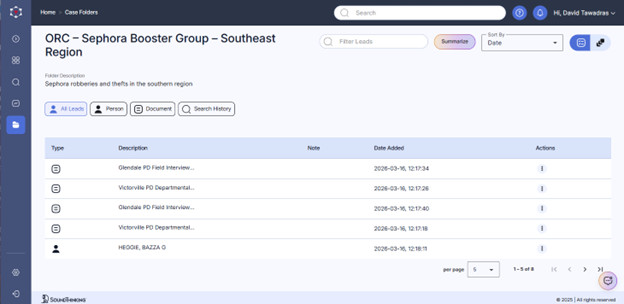
Key Feature #4: Case Folders Turn Agency and Cross-Jurisdictional Cases into a Shared Workspace

Investigations rarely stay inside one department's boundaries. A suspect generates records in one county, a vehicle turns up in another, and a warrant surfaces in a third. Without a shared system, those pieces sit in separate databases until an investigator makes the right phone call.

CrimeTracer’s case folders solve this by giving investigators from different agencies access to the same workspace. Task force members, county sheriff's offices, and municipal departments working the same case can view the same connections, leads, search results, link analysis, and entity connections in real time, and each can contribute new records as the investigation develops. CrimeTracer case folders let users add notes that collaborators can see, allowing investigators to share updates and add investigative leads visible across case folder users – even in other jurisdictions – in real time. This matters most in cases that already cross jurisdictional lines by nature, including gang activity, organized retail crime, and human trafficking, where evidence and suspects routinely move across county and state lines.

Built-in alerts keep everyone current. When an authorized investigator adds a record or a new search returns a hit tied to the case, everyone with access to the folder is notified. No one has to re-run the same searches every few days.

Case folders also retain search history and connections, which helps when cases go cold. Alerts on cold cases can surface new leads when a search finds a new link.

A Data Foundation and an Intelligence Network Work Better Together

Budget constraints and staffing shortages put steady pressure on police departments to do more with less. Technology helps most when each tool has a clear job.

A city-wide data repository such as Peregrine gives agencies a single search across multiple systems. CrimeTracer adds the intelligence: advanced algorithms that connect the dots, extend the search beyond city lines, and turn records into leads that solve crimes. Together, they give patrol, analysts, investigators, and command staff both the data and the answers.

Was this article helpful?

David Tawadras

About the Author

David Tawadras

David has dedicated the last seven years to advancing the public safety industry, creating and implementing cutting-edge technologies that aid the largest law enforcement agencies across the United States. With over a decade of experience leading technology companies, David now serves as Senior Director of Product at SoundThinking. His technological expertise and understanding of public safety requirements drive his commitment to innovation and maintaining the highest standards of safety and efficiency.

View Author Profile

Search for More Insights