See How Miami PD Integrates RTCC and CGIC Workflows to Drive Investigative Outcomes
Beyond the Venue: Operational Intelligence and the New Standard for Major Event Security

The FIFA World Cup may have ended, but the public safety lessons it reinforced will shape major event operations long after the final whistle.
Across host communities, security extended far beyond stadium gates. Agencies and their partners had to account for fan gathering areas, hotels, training sites, transportation corridors, parking zones, entertainment districts, restaurants, pedestrian routes, and other public spaces that became part of the event environment. The tournament offered a highly visible example of a challenge communities face at every scale: a major public event can transform normal operating conditions within hours.
The same shift occurs during professional and college sporting events, concerts, festivals, marathons, parades, political gatherings, and holiday celebrations. Crowd movement changes. Temporary gathering places emerge. Traffic patterns become less predictable. Calls for service compete with event-related demands. An incident miles from the primary venue can still affect the safety, mobility, and confidence of everyone involved.
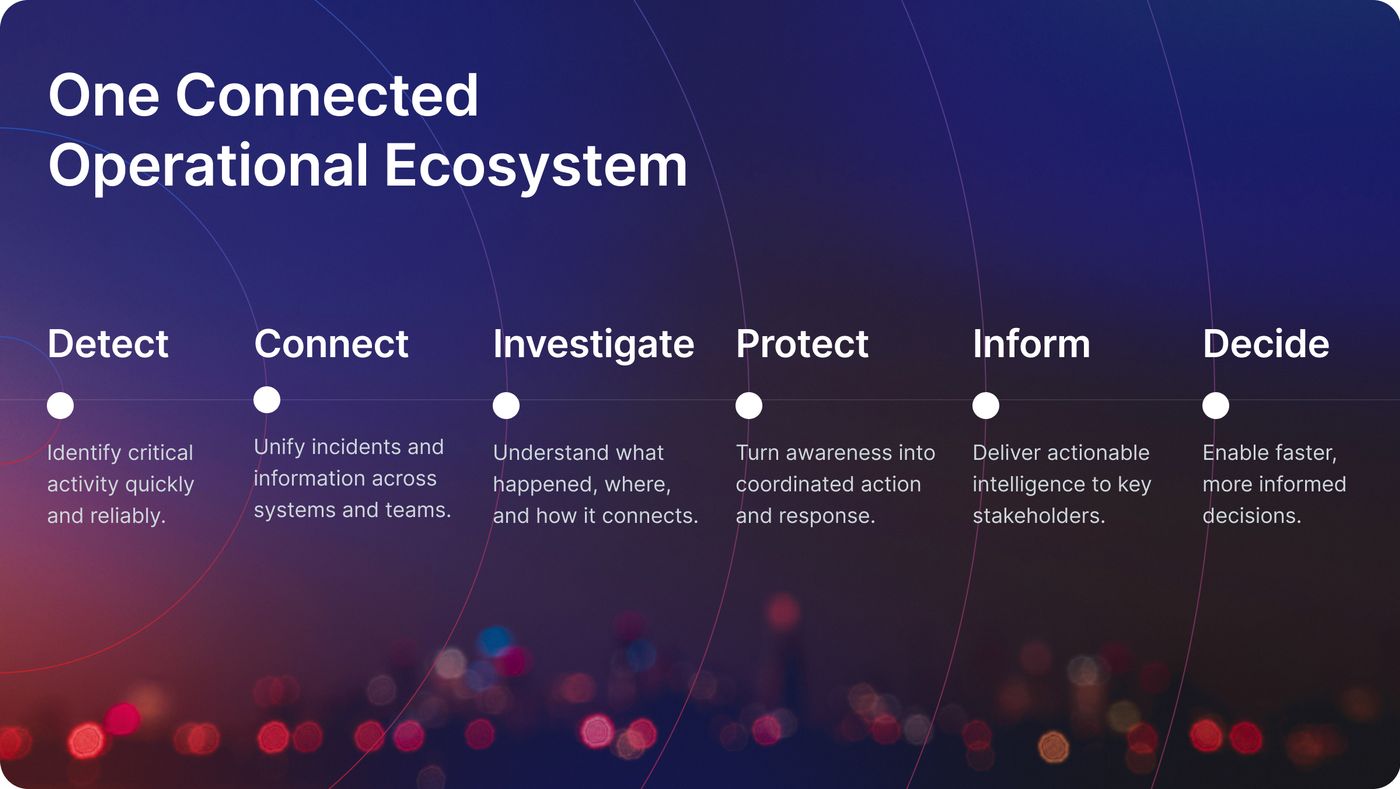
This reality is creating a new standard for major event security. Agencies are still expected to respond effectively when an incident occurs, but increasingly they must also anticipate changing conditions, coordinate across organizations, maintain awareness across a broader operational landscape, and learn from each event. Meeting that standard requires more than a collection of disconnected technologies. It requires a connected operational ecosystem that can turn trusted signals into context, context into coordinated action, and action into better-informed decisions.
Security No Longer Ends at the Gate
Venue security remains essential. Entry screening, perimeter protection, access control, and the safety of people inside a stadium or arena will always matter. But the venue is only one part of the operational picture.
Before an event begins, attendees gather in restaurants, hotels, parking areas, and transit stations. During the event, thousands of people move through surrounding neighborhoods and transportation networks. Afterward, crowds disperse unevenly, celebrations continue, traffic congestion intensifies, and public safety resources may be pulled in several directions at once.
The event therefore extends wherever people, traffic, public activity, and response demands move. Understanding that broader footprint is the first step toward effective readiness. It allows agencies to look beyond a single address and plan for the connected network of places and conditions that may influence the operation.
From Incident Response to Operational Readiness
Major event planning is not about predicting every possible incident. No plan can eliminate uncertainty. The goal is to reduce it.
Operational readiness means using historical activity, local knowledge, prior event experience, geographic context, and real-time information to understand where demand may increase and how conditions may change. It means identifying pressure points before crowds arrive, clarifying roles among partners, positioning resources with purpose, and preserving the flexibility to adapt as the event unfolds.
Historical data can reveal patterns that assumptions may miss. Agencies can examine whether previous activity concentrated near transportation hubs, entertainment districts, parking areas, or common gathering locations. They can compare planned event hours with typical patterns and identify locations where pedestrian traffic, vehicle congestion, or emergency response demand may increase.
Tools such as InSight and Field Agent can help agencies explore historical and operational data, identify patterns across time and geography, and turn that information into context that supports planning, deployment, and coordination decisions. Data does not replace professional judgment. It gives experienced professionals a stronger foundation for using it.
Trusted Detection Is the Foundation
Operational intelligence is only as strong as the information feeding it. During large public gatherings, that foundation is tested under some of the most difficult conditions public safety technology will encounter.
Fireworks, amplified music, engine noise, construction, crowd activity, and other loud impulsive sounds can overlap across a dense, high-decibel environment. These conditions make gunfire harder for people to hear and harder for technology to classify with confidence. They also raise the consequences of a missed or delayed detection because so many people may be concentrated nearby.
This is where proven acoustic intelligence matters. The value is not simply the ability to generate an alert. It is the ability to perform within real cities, across complex terrain, during the loudest and most chaotic periods of the year. That requires sensor coverage suited to the environment, detection and review processes refined through real deployments, and an evidence base developed over repeated event cycles.
A platform promise or product roadmap cannot substitute for that track record. SoundThinking's differentiation begins with technology that has operated under these conditions and with customers that have used years of detection data to shape real staffing and public safety decisions. Historical gunfire data from repeated high-activity periods, for example, can help an agency identify where activity has concentrated, deploy resources more intentionally, and evaluate whether patterns change over time.
No acoustic system is flawless, particularly when fireworks and gunfire may occur simultaneously. Credibility comes from acknowledging the complexity while demonstrating that the technology has been tested, tuned, and used operationally in the environments where confidence matters most.
One Connected Operational Ecosystem
Detection is the beginning of the operational cycle, not the end. The greater value emerges when information moves through a connected ecosystem and becomes usable context for the people responsible for public safety.

This logic is especially relevant during major events because no single alert, data source, dashboard, or agency can provide the entire operational picture. A trusted detection may identify a critical incident. Operational intelligence can place that incident within geographic and historical context. Investigative capabilities such as CrimeTracer can help personnel understand related activity, while protective technologies such as SafePointe can extend awareness to sensitive locations. Together, connected capabilities strengthen the path from the first signal to coordinated action and informed decision-making.
The point is not to make every technology do the same job. It is to help information move across the operational lifecycle so the people responsible for public safety can understand what matters, share context, and act with greater confidence.
Maintaining Awareness as Conditions Change
Once an event begins, the operational picture moves continuously. Crowds arrive and leave in waves. Transportation disruptions redirect people through unexpected areas. Spontaneous gatherings form. Weather, medical calls, traffic incidents, celebrations, and criminal activity may all compete for limited attention and resources.
In this environment, situational awareness cannot stop at the venue boundary. Leaders need to understand what is happening across the broader event footprint and how separate incidents may relate to crowd locations, traffic routes, historical patterns, or other developing activity.
A single incident may initially appear isolated. Placed within a connected operational picture, it may carry different significance. The surrounding context can help leaders determine whether to reposition resources, notify a partner agency, adjust traffic control, expand monitoring, or prepare for additional demand.
The purpose of technology is not to automate judgment. It is to help the right people recognize what matters sooner and make better decisions under pressure.
Coordination Is a Capability, Not a Meeting
Major events often involve law enforcement, fire and emergency medical services, emergency management, transportation agencies, private security, venue operators, promoters, municipal leaders, and regional partners. Each organization may hold a different piece of the picture, but their decisions affect one another.
Effective coordination requires more than bringing stakeholders together before the event. It depends on clear roles, shared information, consistent communication, and a common understanding of the operating environment. A connected ecosystem supports that coordination by helping partners work from more consistent information and by strengthening the path from detection to action.
Technology cannot replace relationships or planning. It can, however, reduce fragmentation. When incidents, investigations, actionable intelligence, and operational context are connected, agencies are better positioned to coordinate across boundaries without losing time reconstructing the situation from disconnected sources.
Learning After the Crowds Leave
A major event should not be considered complete when the final attendee leaves. The period afterward is part of the operational cycle.
Where did activity increase? Which locations generated unexpected demand? Were resources positioned effectively? Did incident patterns shift as crowds arrived and departed? Were there gaps in coverage, communication, or visibility? Which decisions should be repeated, changed, or avoided during the next event?
Post-event analysis allows agencies to answer these questions with evidence rather than memory alone. Using InSight with ShotSpotter® and other sources of operational data, departments can compare event-period activity with historical baselines, evaluate geographic and temporal patterns, and preserve lessons that strengthen future planning.
Each event can become a source of institutional knowledge rather than an isolated operation. The information generated before, during, and after the event can strengthen the next planning cycle and help agencies make more informed decisions over time.
The New Standard
The World Cup offered a powerful case study in how a major event can reshape an entire community. Its most important public safety lesson was not limited to soccer or to the cities that hosted matches.
The lesson is that major event security has entered a new era.
Protecting the venue remains essential, but agencies must also understand the broader footprint, prepare for changing conditions, maintain awareness as activity moves, coordinate across organizational boundaries, and learn from the information generated throughout the operation.
Public safety organizations are no longer evaluated solely by how quickly they respond after an incident. They are increasingly measured by how well they anticipate, connect, communicate, adapt, and reduce uncertainty before conditions become critical.
The future is not simply more technology. It is a connected operational ecosystem in which trusted detection, actionable intelligence, investigation, protection, coordination, and decision-making reinforce one another.
Whether the next major gathering is a professional sporting event, a college game, a concert, a festival, a marathon, a parade, or a holiday celebration, the communities best positioned for success will be those that treat operational intelligence as a continuous process - before, during, and after the event.
Was this article helpful?


Search for More Insights
Here are some other topics you might be interested in: