First Annual Report
Gunfire incidents increased steadily toward the end of the week


Modern public safety depends on more than rapid response. Cities need the ability to recognize patterns, anticipate risk, and deploy resources with precision.
In 2025, Niterói, Brazil took a major step in that direction by integrating ShotSpotter gunshot detection data into a citywide, intelligence-led policing strategy. The result was not simply faster response to gunfire, but a repeatable model for turning real-time data into proactive, life-preserving public safety decisions.
Gunshot detection technology generates thousands of data points. But without analysis, those alerts remain reactive.
Niterói’s Municipal Intelligence Office addressed this challenge by producing its first annual report of firearm discharge events. The report transformed georeferenced gunfire detections into structured intelligence, organized by location, time of day, day of week, and recurrence, and designed for direct operational use.
First Annual Report
This shift marked a move away from incident-by-incident response toward intelligence-led public safety planning.
Temporal analysis showed firearm violence in Niterói followed clear, predictable patterns rather than random distribution.
Key findings included:
Gunfire incidents increased steadily toward the end of the week
Fridays and weekends consistently showed the highest volume
More than 83% of confirmed discharges occurred at night or in the early morning, during low-visibility periods
These insights enabled leaders to align staffing levels, patrol schedules, and preventive presence with historically higher-risk time windows, supporting proactive deployment instead of reactive overload.
Gun violence was not evenly distributed across the city. Advanced spatial analysis, including heatmaps and recurring clusters, showed firearm discharges concentrated persistently in a small number of neighborhoods, forming stable risk nodes rather than shifting hotspots.
This overview allowed public safety teams to:
Focus sustained attention on high-risk areas
Design interventions tailored to neighborhood-specific realities
Optimize limited resources without over-policing lower-risk zones
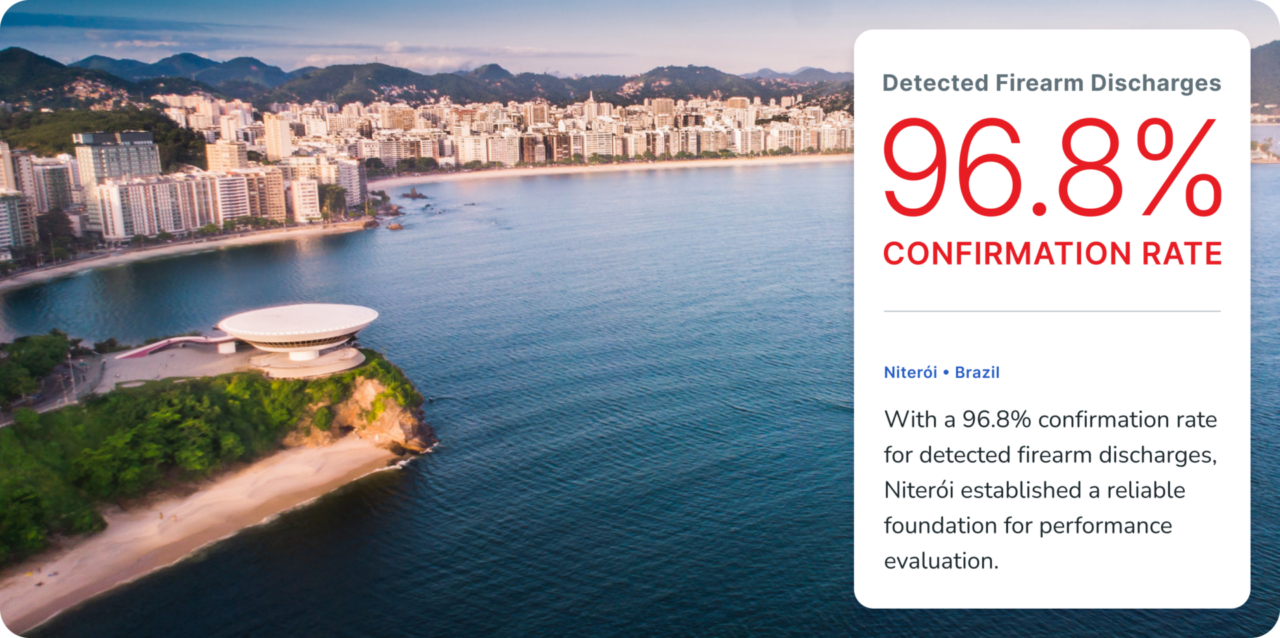
With a 96.8% confirmation rate for detected firearm discharges, Niterói established a reliable foundation for performance evaluation.
The city began tracking:
Changes in firearm discharge volume within priority neighborhoods
Response coverage during night and early-morning hours
Evolution of spatial clusters over time
These metrics enabled continuous adjustment—grounding public safety strategy in evidence rather than assumptions.
Niterói embedded ShotSpotter insights into its Integrated Public Safety Center (CISP), municipal operational logs, and state-level indicators, creating a shared operational picture across agencies.
This integration improved:
Strategic alignment between intelligence and operations
Coordination across municipal and state partners
Consistency in planning, execution, and performance review
The result was clearer situational awareness and faster, more informed decision-making across the public safety ecosystem.
Niterói’s experience demonstrates that technology alone does not improve safety. Interpretation does.
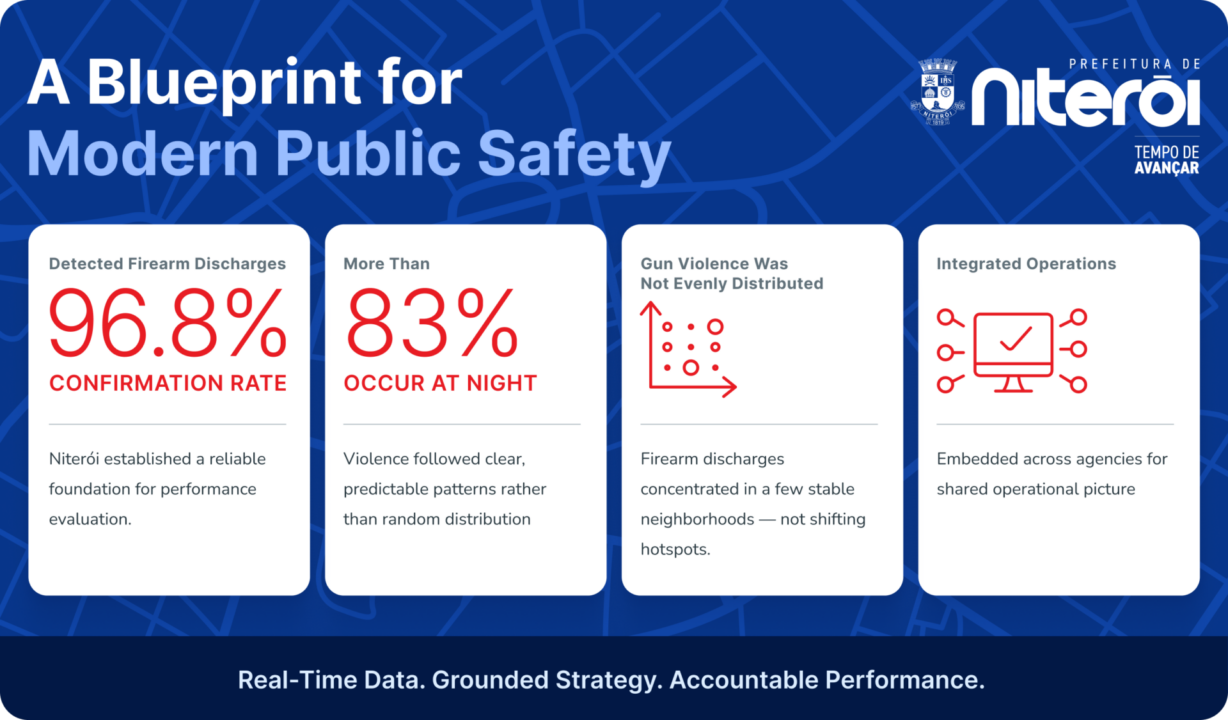
By embedding gunshot detection data into intelligence workflows, operational planning, and performance review, the city strengthened its ability to anticipate risk, deploy resources effectively, and support proactive, life-preserving public safety.
For cities seeking to modernize policing while maintaining accountability and trust, the Niterói model offers a clear lesson: when data becomes shared understanding, prevention becomes possible.
Learn More About ShotSpotter