Watch Our On-Demand Layering Physical Security Webinar Here
Layers of Physical Security for Hospitals


Implementing layers of physical security in hospitals is currently a top priority amid reports of rising workplace violence in healthcare facilities. A meta-analysis of 47 observational studies reported that the overall prevalence of workplace violence against healthcare professionals was 62.4%, with verbal abuse accounting for the highest majority (61.2%) and physical violence representing a substantial 13.7% of incidents.
Faced with these troubling statistics, hospital security departments are being called upon to develop robust physical security layering strategies to keep patients and healthcare providers safe. But what does this entail?
This article will review the proactive measures security departments can take to optimize safety and the critical role a weapons detection system plays in keeping weapons out of hospitals.
What are Layers of Physical Security?
Layers of physical security are best described as a strategy that uses multiple layers of protection to prevent, detect, and respond to critical threats. In overseeing the security of a hospital environment, layers of physical security can include many types of preventative measures designed to discourage abusive behavior and the possession of weapons.
Preventative Layers of Physical Security
Placing cameras (including LPR cameras) in the hospital parking lot is one preventative measure that security teams can implement, as research indicates that cameras in parking lots can be an effective crime deterrent. Furthermore, in the event a crime is committed, LPRs can serve as a helpful tool for identifying suspect vehicles and assisting with investigative follow-up.
Clear signage and audio recordings communicating that abusive behavior won’t be tolerated and weapons are not permitted are also critically important preventative measures. It can also be beneficial to remind visitors of legal ramifications: assaulting a healthcare provider is classified as a felony. All this communication can serve as several effective physical security layers that collectively prevent weapons from entering your facility.
Two-way radio communication devices are also an indispensable physical security layer for security departments, as they enable security teams to easily communicate with one another regarding suspicious weapons or activity. Panic buttons and/or automatic door lock mechanisms are also important from a physical security layer standpoint, as they can help prevent weapons from entering the facility.
Weapons Detection Systems — One of the Key Layers of Physical Security
While the preventative measures outlined above are essential to a robust security strategy, integrating them with a weapons detection system is crucial to ensuring optimal patient safety.
SafePointe, an AI-powered weapons detection solution, is specifically designed to address the unique security challenges faced by hospital environments. Let’s explore these challenges and examine how SafePointe can effectively address them, ultimately enhancing patient safety.
| CHALLENGE | SOLUTION |
|---|---|
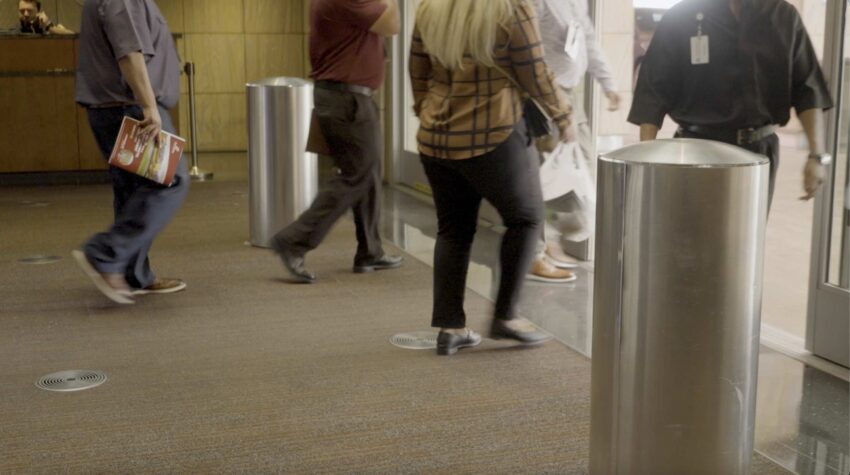
| Challenge # 1: Traditional metal detectors can create a sense of intrusion and discomfort for visitors entering the premises. In the inherently high-stress environment of a hospital, such visible security measures may amplify concerns about the threat of gun violence, leading to increased anxiety. | Solution # 1: Unlike conventional, highly visible weapon detection systems, SafePointe offers a discreet alternative. Designed to blend seamlessly into the hospital setting, it can be installed as inconspicuous elements like bollards or planters, or even remain entirely out of sight, ensuring a less intrusive experience for visitors. |
| Challenge # 2: Traditional metal detectors often result in long queues, irritated visitors, and overburdened security staff, ultimately compromising the visitor experience and the overall effectiveness of the screening process. | Solution # 2: SafePointe offers a streamlined and efficient screening solution designed to accommodate high foot traffic. Its free-flow technology allows visitors to pass through quickly and effortlessly, ensuring both a smooth experience and enhanced security. |
| Challenge # 3: Traditional metal detectors often feature narrow pathways, making it challenging for individuals to navigate and creating long queues. Additionally, many detectors rely on active magnetic field-generating sensors, which can interfere with medical devices like pacemakers. | Solution #3: SafePointe’s design includes bollards spaced 8 feet apart, offering ample room and easier access, increasing throughput and lessening entryway bottlenecks. SafePointe uses passive sensors, ensuring compatibility and safety for individuals with medical devices such as pacemakers. |
| Challenge # 4: Identifying individuals carrying weapons and responding swiftly to potential threats can be a significant challenge. | Solution # 4: SafePointe’s advanced 3D camera combines motion tracking with magnetic moment data to scan multiple individuals at once. Utilizing an NVIDIA® edge processor, its AI-driven system detects potential weapons in real time. When a weapon is identified, an alert is sent to trained analysts at SafePointe’s Alert Review Center, where the information is reviewed and verified within ten seconds. If deemed a legitimate threat, the analyst assigns a threat level, triggering a digital alert to the facility’s security team via the SafePointe app or text, ensuring a rapid response to uphold patient safety. |
Layers of Physical Security for Hospitals: A Comprehensive Approach
Ensuring safety in a hospital setting is a vital responsibility that demands a comprehensive, multi-faceted approach. By combining the recommended preventative measures with a weapons detection system like SafePointe, your layers of physical security can effectively mitigate safety risks and promote a secure environment for your healthcare facility.
Download Weapons Detection Protocol Checklist
Was this article helpful?




Search for More Insights
Here are some other topics you might be interested in: